
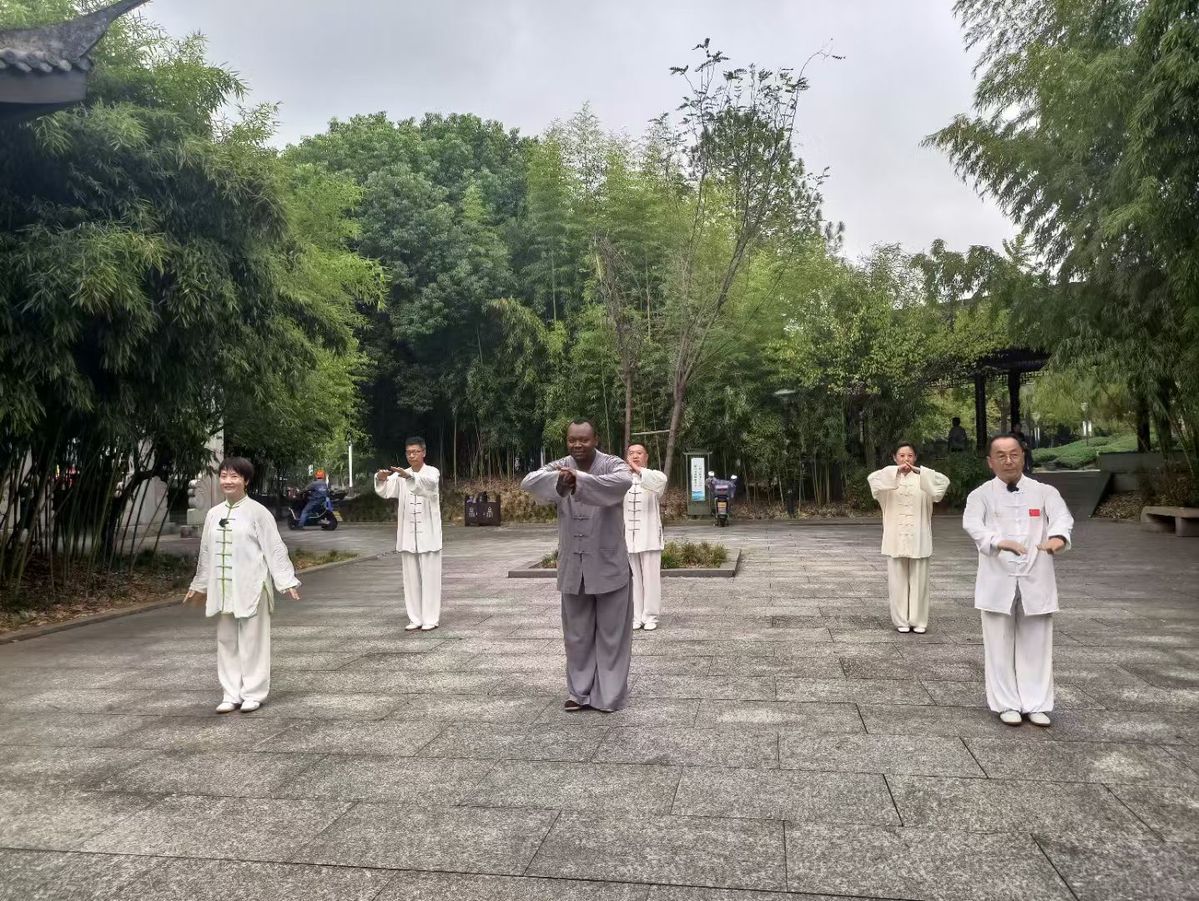
 Taling Tene Rodrigue (center) practices a traditional Chinese martial arts salute. PROVIDED TO CHINA DAILY
Growing up in Cameroon, Taling Tene Rodrigue was fascinated by scenes in Chinese kung fu movies. Two people might be eating with chopsticks one moment, only to turn them into weapons the next. Martial arts masters would leap through the air, seemingly defying gravity.
Rodrigue first discovered these movies on DVD about two decades ago. Some were neither dubbed nor subtitled in a language he understood, but that hardly diminished his enjoyment.
"I was amazed by Bruce Lee's fierce fighting, Jackie Chan's funny drunken boxing and Jet Li's ability to leap across rooftops and walls. I really thought everyone in China practiced kung fu, so I decided that when I grew up, I would go to China and see for myself," he recalled.
In late 2011, Rodrigue traveled to China for the first time.
While studying at Zhejiang Normal University in Jinhua, Zhejiang province, he made friends with Chinese students who shared his passion for martial arts. One of them invited Rodrigue to his family's home in the Zhejiang countryside during Spring Festival, where he practiced on a wooden training dummy belonging to his friend's father.
A teacher skilled in traditional tai chi also played an important role in his journey. Rodrigue frequently visited the teacher's martial arts school, where he watched children practice and sometimes joined them before teaching them some English. From the teacher, he learned tai chi, Chinese wrestling and Xingyiquan, a traditional martial art known for its direct, powerful movements.
Rodrigue also visited the Shaolin Temple in Henan province, one of China's most influential centers of traditional martial arts, twice.
On one visit, he joined a three-month Shaolin kung fu training program that brought more than a dozen enthusiasts from African countries to the temple. They practiced martial arts and learned about traditional Chinese culture, including traditional Chinese medicine practices such as acupuncture.
The more Rodrigue learned about Chinese kung fu, the more he began to reflect on the martial arts traditions he knew from Africa. How had different cultures developed their own martial arts traditions, and what might they learn from one another?
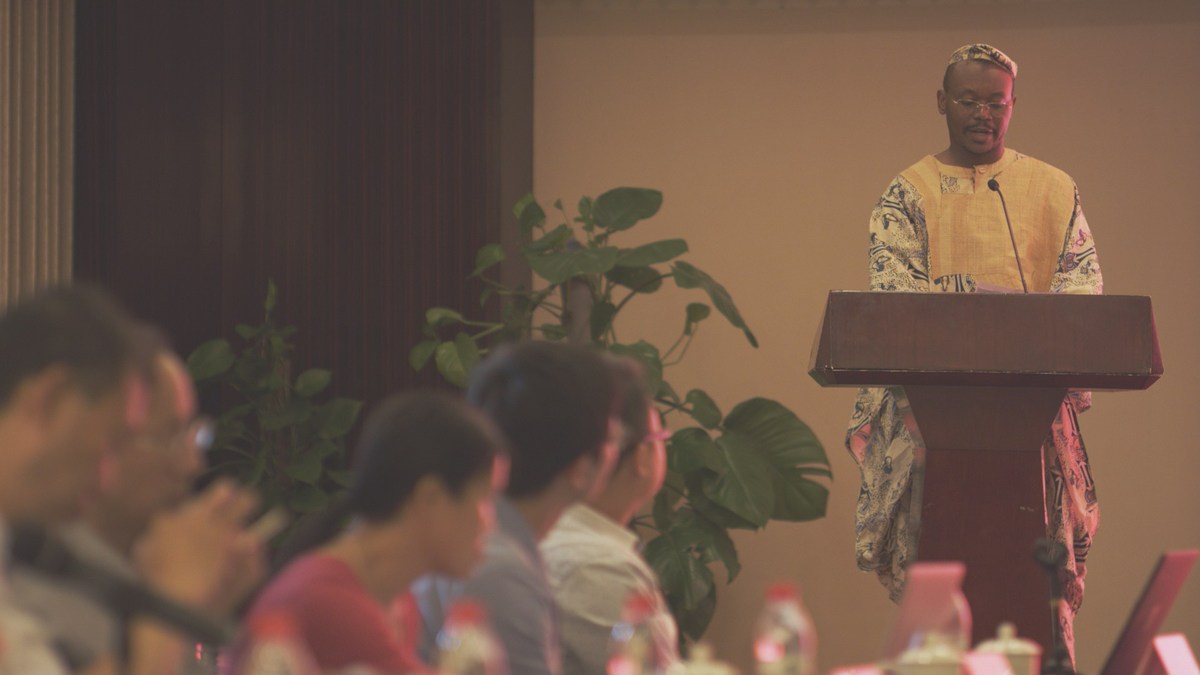 Rodrigue delivers a speech wearing traditional Cameroonian attire. PROVIDED TO CHINA DAILY
Beyond the moves
For Rodrigue, African and Chinese martial arts share roots in humanity's efforts to protect itself and adapt to the natural environment.
He also saw parallels in the influence of animals on both traditions. Chinese styles include Tiger Boxing and Praying Mantis Boxing, while in some African traditions, the leopard symbolizes courage and strength and has also influenced local martial arts practices.
There were differences, too. Rodrigue observed that Chinese kung fu often features structured routines that people can practice for fitness and well-being. In some African traditions, meanwhile, fighting and self-defense techniques are incorporated into dance and intertwined with rituals, beliefs and people's relationship with nature.
These observations became the starting point for his academic research.
While pursuing a doctorate at Shanghai University of Sport, Rodrigue gradually realized that some existing studies emphasized how Chinese kung fu was introduced to Africa while paying less attention to Africa's own martial traditions and how Africans interpreted it through their own cultural experiences.
"We are learning Chinese martial arts, but what can we introduce to our Chinese friends in return?" he said.
That question became central to his work.
In August 2026, Rodrigue published a book, Transmission and Exchanges of African Martial Arts and Chinese Wushu: A Philosophical Hermeneutic Study.
Written from his perspective as an African scholar, the book explores the two martial arts traditions and how they have been transmitted, interpreted and shared across cultures.
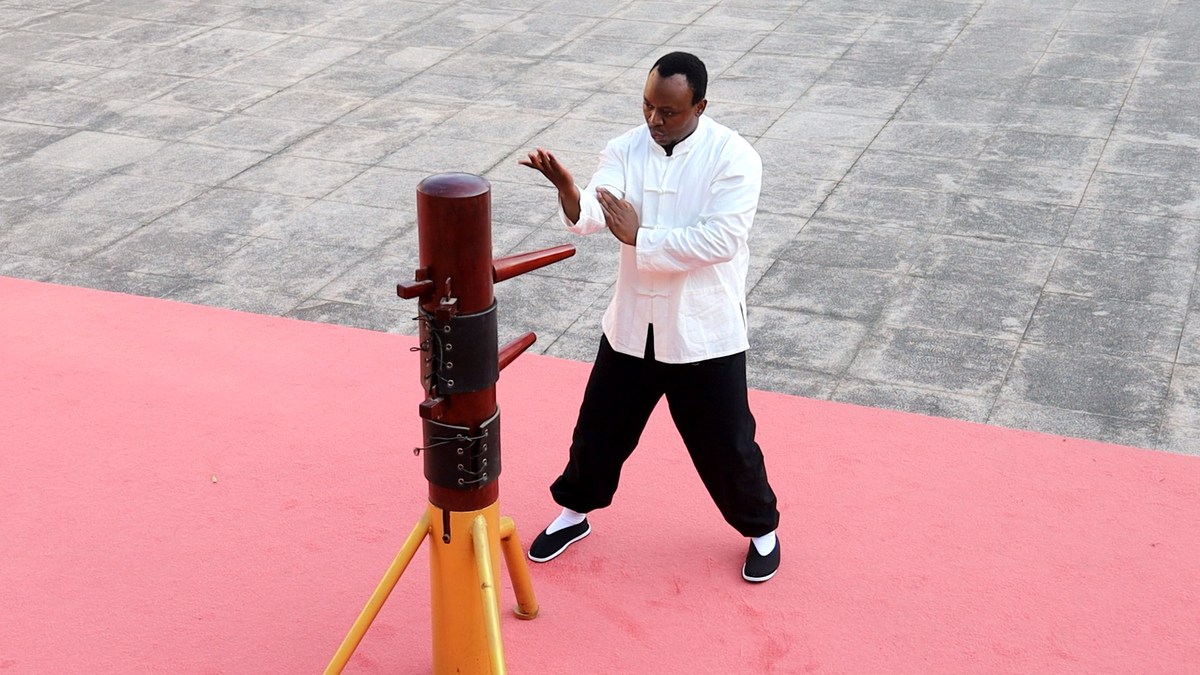 Rodrigue trains with a wooden martial arts dummy. PROVIDED TO CHINA DAILY
Ideas in action
But Rodrigue was not content to keep his research confined to the pages of a book. His fascination with kung fu movies had never faded.
After appearing in a Chinese kung fu movie, he became more deeply involved in filmmaking, taking on three roles in the China-Africa co-production Kung Fu Dream: chief director, African-side screenwriter and lead actor.
Inspired by Rodrigue's own journey, the film tells the story of a young African man whose love of Chinese kung fu takes him to China, where he eventually pursues research into martial arts and cross-cultural exchange.
"No one understands my story better than I do," he said.
For Rodrigue, however, telling that story was about more than putting his own experience on screen.
Involving African filmmakers in screenwriting and directing, he said, also meant bringing African storytelling traditions and cultural perspectives into the filmmaking process.
According to Rodrigue, Kung Fu Dream received a public screening permit in China in 2026, with plans to reach audiences in 12 African countries.
He is now planning another China-Africa action film, hoping to involve more African talent both in front of and behind the camera and create career opportunities for young people passionate about martial arts.
Rodrigue's efforts to make cultural exchange work in both directions extend beyond research and filmmaking. He has founded the China-Cameroon Linguistic and Cultural Center in Cameroon, where martial arts play an important role in activities promoting language learning and cross-cultural understanding.
The center has helped organize school activities under the theme "Martial Arts and Self-Discipline" to show students and parents that practicing martial arts is not just about learning to fight but can also help children develop self-control.
It also organizes martial arts performances featuring local practitioners and Chinese participants, who sometimes join in African dances as well.
What began as a childhood fascination with kung fu has since grown into a book, a film and a broader mission to foster two-way cultural understanding.
Rodrigue sees kung fu as a window through which he first discovered China. Now, he hopes to use that same window to help more Chinese people discover Africa.

