
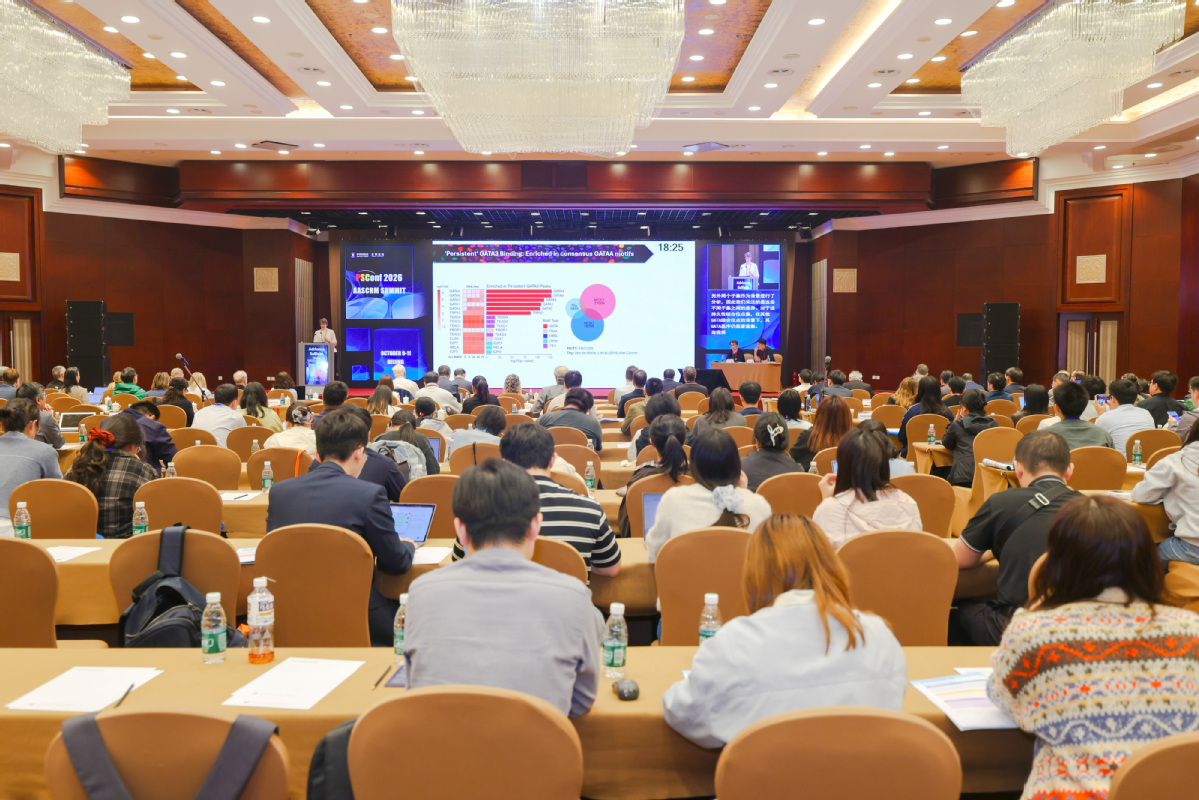
 The Pluripotent Stem Cell Conference is held in Beijing from Oct 9 to Oct 11.[Photo provided to chinadaily.com.cn]
China's role in advancing stem cell research for regenerative medicine and drug testing took center stage at a global forum in Beijing, where scientists from around the world also called for stronger efforts to translate research into clinical applications, build consensus on standards and deepen international cooperation.
Stem cells, often described as the body's master cells, can develop into different cell types. Under appropriate culture conditions, they can also form organoids — miniature, functional models of human organs. These capabilities make stem cells valuable for regenerating damaged tissues and provide organoids with the potential to serve as human-relevant platforms for drug testing.
"Human stem cell research has reached a critical juncture, accelerating from basic discovery to clinical translation," said Cheng Tao, a member of the Chinese Academy of Engineering and a professor at Peking Union Medical College and the Chinese Academy of Medical Sciences.
Cheng stressed the need for coordinated efforts across disciplines, regions and countries to advance basic research into organ regeneration and scale up stem cell therapies for clinical use. He called for closer collaboration among researchers, clinicians, industry representatives and regulatory bodies.
He made the remarks at the Pluripotent Stem Cell Conference, an annual global forum held from Friday to Sunday that aims to bridge pioneering laboratory discoveries and clinical applications while fostering international collaboration. This year's event, themed "Pathways to Organ Regeneration: State of the Art in Underpinning Science and Technology," attracted more than 500 scientists from countries including China, the United States, the United Kingdom and Australia.
Zhou Qi, chair of the board at the Beijing Institute for Stem Cell and Regenerative Medicine, said the forum, now in its sixth year, has provided a platform for international experts to exchange academic insights, explore data-sharing arrangements and establish long-term cooperation mechanisms. These efforts, he said, are intended to consolidate global research efforts and ultimately translate cutting-edge discoveries into tangible benefits for patients.
Tracing China's progress in stem cell research, Zhou cited the establishment of the country's first stem cell banks and earlier debates over the definition of "clinical-grade" cells as important steps toward addressing challenges in clinical translation. The discussion has since expanded to the international stage, with researchers focusing on obstacles including scalable manufacturing, quality control and regulatory science.
"The discussion on international standards is not only for cells, but for data and everything," Zhou said. "We really need all the experts to meet together to let this field move smoothly and move in the right direction."
The development of stem cell research also depends on major scientific facilities that can help researchers investigate biological processes in greater depth, said Han Jian, deputy director of the administrative committee of Huairou Science City in Beijing.
While conventional microscopes can provide static, two-dimensional images, advanced scientific facilities offer the multiscale and multimodal tools needed to investigate how stem cells self-organize into complex tissues and assess the reliability of the resulting organoids, Han said.
Huairou district now operates 37 major scientific facilities, 14 of which are related to life and health sciences. Building on this concentration of research infrastructure, the district is developing a biomedical innovation ecosystem spanning basic research, model development, clinical translation and industrial applications, Han said.
He highlighted the Human Organ Physiopathology Emulation system, or HOPE, an integrated platform for stem cell-based organ research whose construction began in 2024. The system aims to enable the scalable production of centimeter-scale organoids and can model more than 20 pathological conditions across multiple scenarios.
A key objective of HOPE is to standardize the collection and integration of molecular, cellular, imaging, physiological and omics data, making research findings from different laboratories more comparable and reusable.
Alfonso Martinez Arias, a professor at Pompeu Fabra University in Spain, also emphasized the importance of standardization in generating comparable data and reproducible models, both of which are essential to advancing the field.
During a visit to the HOPE facility, Arias described it as "breathtaking" and said the development of Huairou Science City was "distinctly futuristic".
"What is being done here is of great significance to the development of the life sciences. It gives us every reason to believe that this will greatly advance technological progress in the biological sciences," he said. "The level here is remarkably advanced. This will inspire similar institutions around the world."
Adrienne Sullivan, a professor at Adelaide University in Australia, also expressed optimism about the project.
"I really look forward to the completion of HOPE. This facility is expected to achieve exciting breakthroughs in organoid production and design," she said.
"Science requires a very open environment," said Zhao Tongbiao, deputy director of the Beijing Institute for Stem Cell and Regeneration.
He said the forum had created opportunities for leading experts worldwide to exchange ideas and added that China's major scientific facilities were open to researchers from all countries for collaborative work. Future progress, he said, would depend on breakthroughs in both basic research and the translation of scientific advances into industrial applications.

