
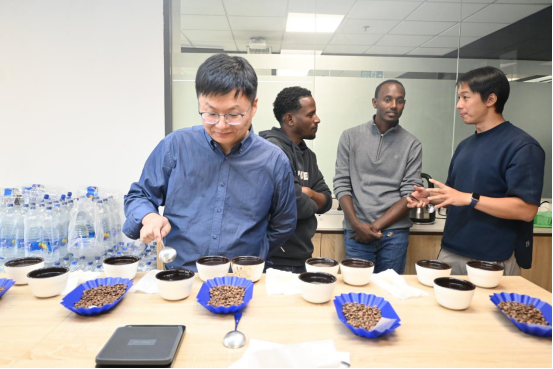
Wang Shuiyong (left) examines coffee beans with Ethiopian traders in 2026. [Photo provided to chinadaily.com.cn]
Coffee beans, originating from the highlands of Ethiopia, travel thousands of kilometers to Central China's Henan province, quietly building a bridge for cross-border industrial cooperation between Henan and Africa.
Upon arrival at the Advanced Manufacturing Development Zone of Puyang county, Henan, beans from the African Plateau undergo a transformation: after roasting, grinding, cold extraction, and freeze-drying, the green beans turn into fragrant freeze-dried coffee cups that are sold to consumers across the country and abroad.
Wang Shuiyong, 44, is chairman of Huichuan Industrial Development (Henan) Co, a coffee enterprise located in the development zone.
In Wang's coffee production base, a cold extraction freeze-drying coffee production line operates under the low-temperature of minus 40 C. While the coffee bean roaster roars, the coffee liquid is transformed into evenly distributed freeze-dried coffee powder through vacuum freeze-drying technology.
Nowadays, the company's installed production capacity stands at 400 metric tons, with a projected increase to 1,000 tons in the next three years.
Wang, a Henan resident, returned to his hometown in 2012 after spending six years working in Beijing. He launched his agricultural processing business in Puyang city, focusing on agricultural integration and freeze-drying technology.

Wang Shuiyong, chairman of Huichuan Industrial Development (Henan) Co. [Photo provided to chinadaily.com.cn]
Years of producing dried fruits, nutritional soup products, as well as beverages helped his team build mature manufacturing systems. In 2019, amid China's booming coffee consumption upgrade, Wang identified packaged freeze-dried coffee as a "blue-ocean" market and established Huichuan.
"At that time, domestic coffee brands were scarce, and the market was long dominated by imported instant products. Unlike the freshly ground store model of chain coffee in the market, I chose to delve into the deep processing track of pre-packaged specialty coffee, focusing on high fidelity flavors, convenient experiences, and high cost-effectiveness," he said.
Wang established a direct procurement supply chain with the local government in 2020.
As the core origin of Arabica coffee worldwide, Ethiopia has top-notch coffee germplasm and flavor resources, which is popular among Chinese consumers. In 2025 China became the fourth-largest importer of Ethiopian coffee, according to a Xinhua News Agency report.
Despite its popularity, Wang identified a structural weakness in the Ethiopian coffee industry: coffee is mostly exported in the form of primary green beans. In order to connect the source supply chain and fill the gaps in the industry, he led a team that would embark on a years-long mission of industrial integration between China and Africa.
In July, Wang's company signed a memorandum with the Ethiopian Investment Commission in Addis Ababa, with the aim of constructing a modern full-cycle coffee deep-processing industrial park in Addis Ababa, integrating bean procurement, sorting, warehousing, deep processing and export.
"We are one of the earliest freeze-dried coffee companies in China to use coffee beans from Ethiopia's entire production area. Nowadays, over 80% of Ethiopia's freeze-dried coffee powder is produced through our company," Wang said.
Powered by the industrial chain, Wang's team developed its own coffee brand named Rami Coffee in 2022, targeting consumers aged 18 to 35, mostly females.

Lu Ying (center) checks coffee beans in Uganda. [Photo provided to chinadaily.com.cn]
"Our freeze-dried coffee can dissolve at any temperature, such as ice water, room-temperature water, or milk, within 3 seconds. It can perfectly integrate into the production environment of American coffee, latte, and various signature drinks," said Lee Hyunkoo, general agent of Rami Coffee in South Korea. "The freeze-drying method of cold extraction focuses on maintaining physical freshness. The taste is fresher and the layers are richer, displaying an advantage in traditional categories."
The company also customizes flavors to suit local residents' preferences.
"The maturity of coffee consumption in Zhongyuan is not as high as that in Beijing, Shanghai, Guangzhou, and Shenzhen. We have developed localized innovations based on the regional characteristics of Henan, such as Jingjie American style coffee, Kaifeng chrysanthemum coffee, Luoyang peony flavored coffee, and other specialty products," said Lu Ying, founder of Rami Coffee.
Looking ahead, Wang said they plan to integrate high-quality African raw materials with Henan manufacturing technology, and build an "African raw materials, Henan manufacturing, global sales" model.
Wang added that they also plan to develop more machine-free coffee shops, which mainly relies on brewing freeze-dried coffee powder.

