
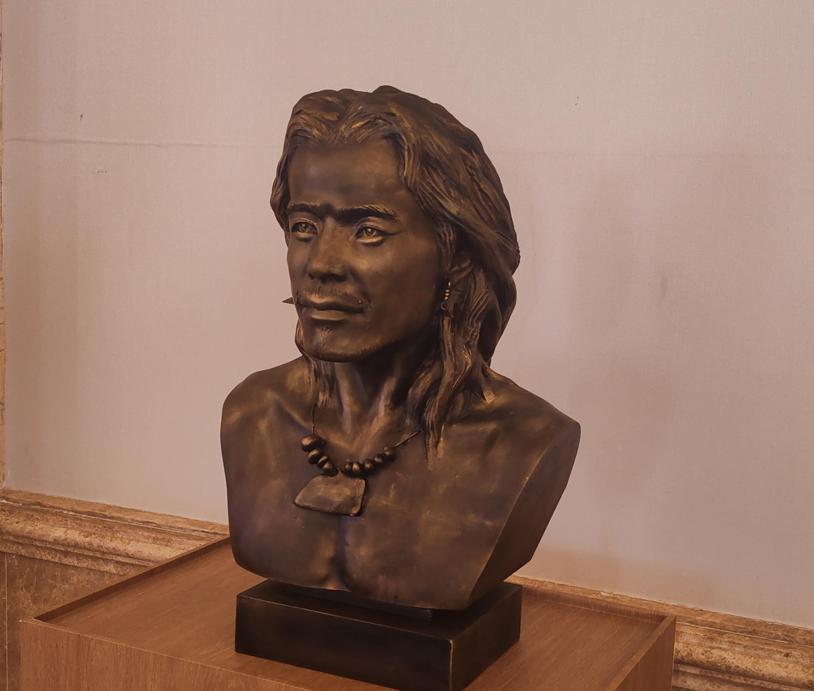
Facial reconstructions of prehistoric humans from China's 8,000-year-old Jiahu culture were unveiled in Zhengzhou, Henan province. [Photo by Qi Xin/chinadaily.com.cn]
Facial reconstructions of prehistoric humans from the ancient Jiahu culture — which existed more than 8,000 years ago — were unveiled on Tuesday in Zhengzhou, Henan province. They give members of the public a glimpse of the appearance and features of their Stone Age predecessors.
Wang Wei, a member of the Chinese Academy of Social Sciences and president of the Henan Provincial Institute of Cultural Heritage and Archaeology, said that researchers have successfully reconstructed the physical features of some Jiahu individuals using human-bone specimens unearthed at the site.
"Cold ancient bones are now brought back to life with reconstructed faces. This is a big breakthrough in scientific archaeology," Wang said. "People can now virtually meet an 8,000-year-old ancestor face to face across time and space," Wang said.
Zhu Hong, a professor at Jilin University's bioarchaeology laboratory, said researchers established — via hip bone observations and tooth wear — that the ancient person was a strong man about 25 to 30 years of age. He had a regular oval skull, a prominent glabella (between the eyebrows above the nose bridge), strong supraorbital ridges, thick cheekbones, firm and flat facial contours and moderately sized nasal structures.
These physical features matched the typical characteristics of prehistoric humans of the ancient Central Plains type, Zhu said.
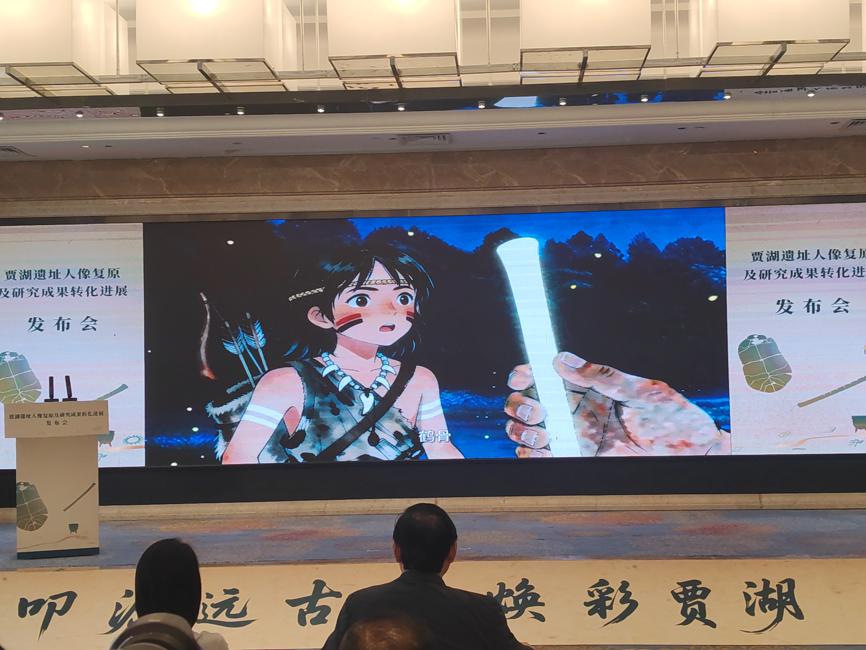
An animation based on evidence from the ancient Jiahu culture is China's first animated work adapted from findings at an archaeological site. [Photo by Qi Xin/chinadaily.com.cn]
To secure maximum authenticity, the research team collected data from high-precision 3D scans and built an accurate three-dimensional skull model.
The Jiahu site is located in Jiahu village in Wuyang county of Luohe, Henan province. Dated roughly to 9,000 to 7,500 years ago, it was a large-scale early Neolithic settlement with rich cultural layers.
Since the first excavations in 1983, archaeologists have uncovered hundreds of tombs and collected abundant human bone samples.
Many valuable relics such as Jiahu bone flutes, tortoise shell objects, pottery and stone tools have been found. They offered important evidence for studying the origins of Chinese civilization.
Images were created as part of China's first animated work adapted from findings at a prehistoric archaeological site.
Gu Wanfa, executive president of the Henan archaeology institute, said that both the scientific facial reconstruction and new animation series have solid academic support and powerful contemporary communication value.
Zhang Juzhong, professor at the University of Science and Technology of China said they also provide vivid physical evidence to explain the origins of the Jiahu civilization
"Those help people better understand Jiahu and prehistoric Central Plains civilizations," Zhang said.

