
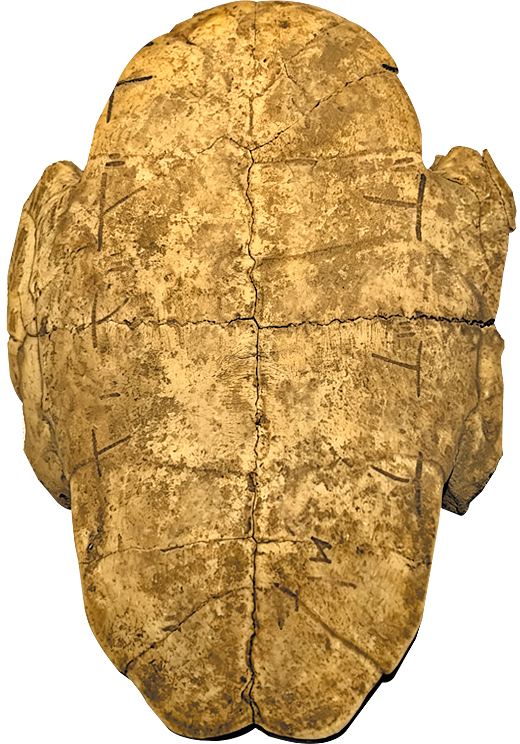
The character for guo, or "state", in oracle bone script. CHINA DAILY
In recent years, hezun, a bronze ritual wine vessel carrying the earliest known written record of zhong guo — a term that later became the Chinese name for China, has been a regular presence at exhibitions across the country.
Cast in the early Western Zhou Dynasty (c.11th century-771 BC), the artifact features the two characters with even earlier origins. Both zhong and guo appear independently in Shang Dynasty (c.16th-11th century BC) oracle-bone inscriptions, where early Chinese ancestors were working out what the two words meant.
Unlike zhong, whose meaning was deciphered shortly after the oracle bones came to light, guo proved far more elusive. Scholars arrived at its correct reading only within the past two decades or so.
Its graph began as the picture of an axe with a round or oval blade fixed to a handle — a weapon first, a character later. As the character evolved, the circular axe-blade element became distinct from the handle stroke.
After this change, the character acquired a varying number of short horizontal or vertical strokes, interpreted as territorial boundaries. Taken in its complete form, the glyph conveyed the notion of securing territory through armed force.
By comparison, the oracle-bone form of zhong resembles a banner with streamers flowing at its top and bottom. Banners of this kind gathered people in peacetime and troops in wartime. They were also used to gauge the sun's shadow and read the wind. From the banner, zhong derived its core meaning of "the middle" or "center".
In the hezun inscription, the term zhong guo did not hold its modern-day national connotation. It is best rendered as "this central region", a purely geographic description.

