
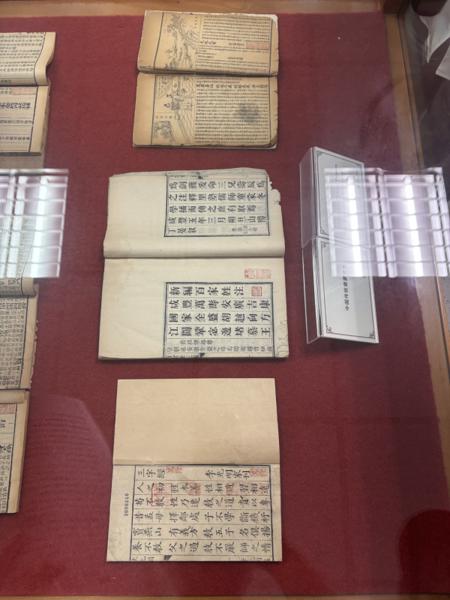
A basic education textbook exhibition is held at the Beijing Normal University Library, which began collecting textbooks in the 1930s. The library now holds more than 80,000 titles and 240,000 volumes of textbooks at various levels and types. [Photo by Zou Shuo/chinadaily.com.cn]
Textbooks serve as living fossils recording China's educational evolution, and a special exhibition hosted by Beijing Normal University Library brings these time-honored teaching materials to light, offering insights into how education has shaped generations of Chinese people, according to librarians at Beijing Normal University.
That idea is at the heart of a basic education textbook exhibition at the Beijing Normal University Library, which began collecting textbooks in the 1930s. The library now holds more than 80,000 titles and 240,000 volumes of textbooks at various levels and types.
Wang Xianfang, the library's director, said textbooks are the foundation and an important carrier of education. "They reflect the interaction between the state and the people," Wang said. The state hopes to shape a certain kind of person, and through textbooks that person is shaped, he said, adding that textbooks are "fossils" in the history of education.
For BNU, a pioneer of modern teacher education in China, preserving and studying textbooks is part of its mission. "Teacher education is our foundation. Studying the history of teacher education and textbooks, and gaining a deeper understanding of educational history, is the mission and responsibility of BNU people," Wang said.
The library has followed a principle of "collecting all that should be collected", especially textbooks dating back to the late Qing Dynasty (1644-1911) and China's republican era (1912-49). Such textbooks are scarce, and few teacher-training universities have comparable holdings, he said.
In 2022, the library launched an online database of textbooks from the period based on its own collection and contributions from other institutions, according to Hu Shenqiu, an associate research librarian at the library.
It covers six categories, including traditional elementary education, primary school, middle school and higher education, teacher training, vocational schools and others. Access is currently limited to campus IP addresses, but usage has been high, she said.
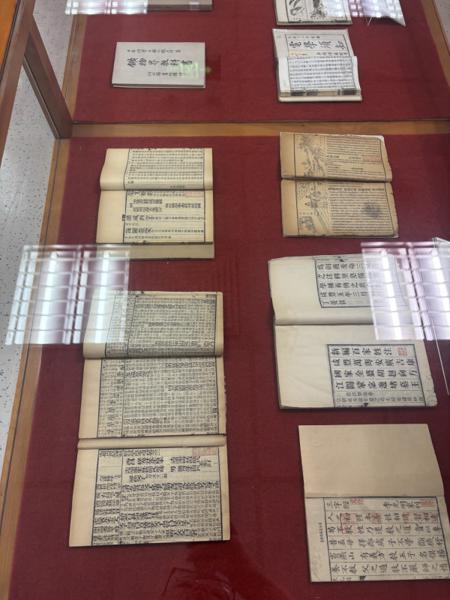
A basic education textbook exhibition is held at the Beijing Normal University Library, which began collecting textbooks in the 1930s. The library now holds more than 80,000 titles and 240,000 volumes of textbooks at various levels and types. [Photo by Zou Shuo/chinadaily.com.cn]
Its physical textbook exhibition uses representative holdings to trace the development of modern textbooks in China — from ancient primers such as Three Character Classic, Hundred Family Surnames and Thousand Character Classic, to modern textbooks in the late Qing Dynasty and early Chinese-authored textbooks, and then to textbooks from the republican era.
The exhibition also includes textbooks compiled during the Chinese People's War of Resistance Against Japanese Aggression (1931-45) and those produced throughout the War of Liberation (1946-49), as well as textbooks published after the founding of New China.
Exhibits also include textbooks printed on coarse Malan paper produced in the Shaanxi-Gansu-Ningxia border region in northwestern China — the cradle of New China.
BNU, a century-old teacher-training university centered on teacher education and basic education, has long valued textbook collection. The history of textbooks is closely tied to the nation's history, Hu said.
Textbook research is not only about education and teaching but is also significant for historical and multidisciplinary research, she said.
Asked whether textbooks remain important in the AI era, Hu said AI cannot easily access ancient textbooks. Knowledge acquisition depends on one's foundation, and such reading materials remain important.
"Some say textbooks shape a person," Hu said. "What kind of person you become is closely related to what textbooks you use."
The library digitized the textbooks because the paper copies are old and unsuitable for frequent use, while their content is precious. The aim is to make these outstanding materials from the past more accessible to researchers, students and textbook enthusiasts.
For teacher-training students, Hu said the exhibition helps them understand the history and stories behind textbooks, such as those printed on Malan paper in the Shaanxi-Gansu-Ningxia border region.
"When they learn this, they will feel emotionally connected to history and textbooks, and it will inspire further research and influence their thoughts," she said.

