
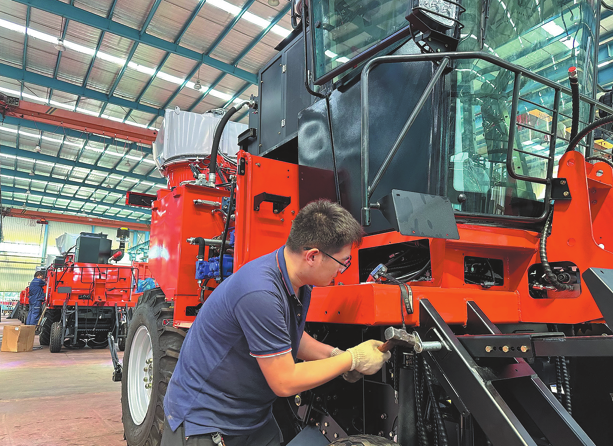
Employees work on sugarcane harvesters at Luoyang Chenhan Agricultural Equipment Technology Co. CHINA DAILY
China imports more than five million metric tons of sugar every year, in part because harvesting sugarcane remains costly.
Zhang Changxian believed one machine could help change that.
When Zhang told industry veterans he wanted to build a Chinese sugarcane harvester, the response was blunt.
"Don't bother," they told him. "No one in China can build this."
Zhang ignored them.
Nearly two decades later, his company, Luoyang Chenhan Agricultural Equipment Technology Co, has become China's leading manufacturer of sugarcane harvesters. Its machines now harvest cane across South China and have expanded into overseas markets including Thailand, Indonesia, Costa Rica and Venezuela.
The journey took eight years, seven major redesigns and, at one point, a remortgaging of Zhang's home.
It also mirrors a broader transformation underway in the country's agricultural machinery industry, where manufacturers are increasingly developing equipment tailored to the country's farming conditions instead of adapting technologies designed overseas.
"When we started, there was no domestic technology we could learn from and no supply chain we could rely on," said Zhang, now chairman of Chenhan. "We had to develop everything ourselves."
Zhang graduated from China Agricultural University's Department of Agricultural Machinery in 1990 and spent more than a decade at YTO Group, China's largest tractor manufacturer. After leaving a State-owned company in 2004 to start his own business, he came across an opportunity that would define his career: building a domestically developed sugarcane harvester.
At first, Chenhan followed the conventional approach. Its engineers designed a machine that harvested whole sugarcane stalks because government agencies and sugar mills preferred intact cane, which fit existing processing systems and could be stored more easily.
The design failed.
Unlike the vast plantations of Brazil and Australia, most of China's sugarcane is grown in Guangxi Zhuang autonomous region and other southern regions, where frequent typhoons leave crops flattened before harvest. Machines designed to collect upright stalks struggled to harvest lodged cane efficiently.
The company abandoned years of development work and started over.
Engineers switched to a chopped-stalk design, developing an integrated chassis with a high-clearance oscillating front axle, a hydrostatic rear-drive system and a high-capacity rear collection hopper capable of operating in the country's more challenging field conditions.
In 2015, after eight years of development and seven generations of prototypes, Chenhan's first chopped-stalk sugarcane harvester passed certification and was included in the country's national agricultural machinery subsidy catalog.
It also won the top prize at the China Agricultural Machinery Science and Technology Awards, with judges recognizing it for solving China's long-standing lack of a domestically developed sugarcane harvester.
For farmers, the impact was immediate.
A worker harvesting sugarcane by hand typically cuts about one metric ton a day. Under suitable field conditions, Zhang said one of its harvesters, operated by two people, can process more than 100 tons in a day — the equivalent of the work done by more than 100 laborers.
Winning farmers' trust, however, took almost as much effort as developing the machine itself.
During Chenhan's earliest field trials in Guangxi, Zhang had to pay farmers about 3,000 yuan ($447) per mu (0.067 hectares) to use their fields for destructive testing.
As the machines improved, attitudes shifted. Farmers first offered their land free of charge, then supplied fuel for testing. Eventually, they became paying customers.
"The more users we had, the more confidence we gained," Zhang said.
The market responded quickly. Chenhan sold more than 30 harvesters in Guangxi in 2016. A year later, sales exceeded 150 machines, each priced at about 900,000 yuan.
Between 2017 and 2019, the company captured as much as 90 percent of the country's sugarcane harvester market. Even after competitors introduced similar products, Chenhan still accounts for roughly half of the country's installed base.
The company is now applying the same approach overseas.
Rather than exporting identical machines, Chenhan adapts its equipment to local conditions. On Reunion island in the Indian Ocean, where volcanic ash soil requires exceptionally low ground pressure, the company replaced conventional wheels with wide crawler tracks and redesigned cooling systems for the tropical climate.
After purchasing two machines for testing, the customer returned this year to order two more.
In Thailand, users estimate a single Chenhan harvester can replace the work of as many as 350 manual laborers, Zhang said.
Exports now account for nearly one-fifth of the company's revenue, with machines operating across Southeast Asia and Latin America.
According to Zhang, overseas customers are no longer choosing Chinese machinery simply because it costs less. Chinese machines are found easier to operate.
"They care first about quality," he said. "Price comes after that."
Despite the progress, Zhang said that Chinese agricultural machinery still trails global leaders in durability, operating efficiency and fuel economy. Closing those gaps has become Chenhan's next challenge.
"The products are becoming more sophisticated," he said. "But in the end, the best machines are the ones designed for the fields where farmers actually work."

