
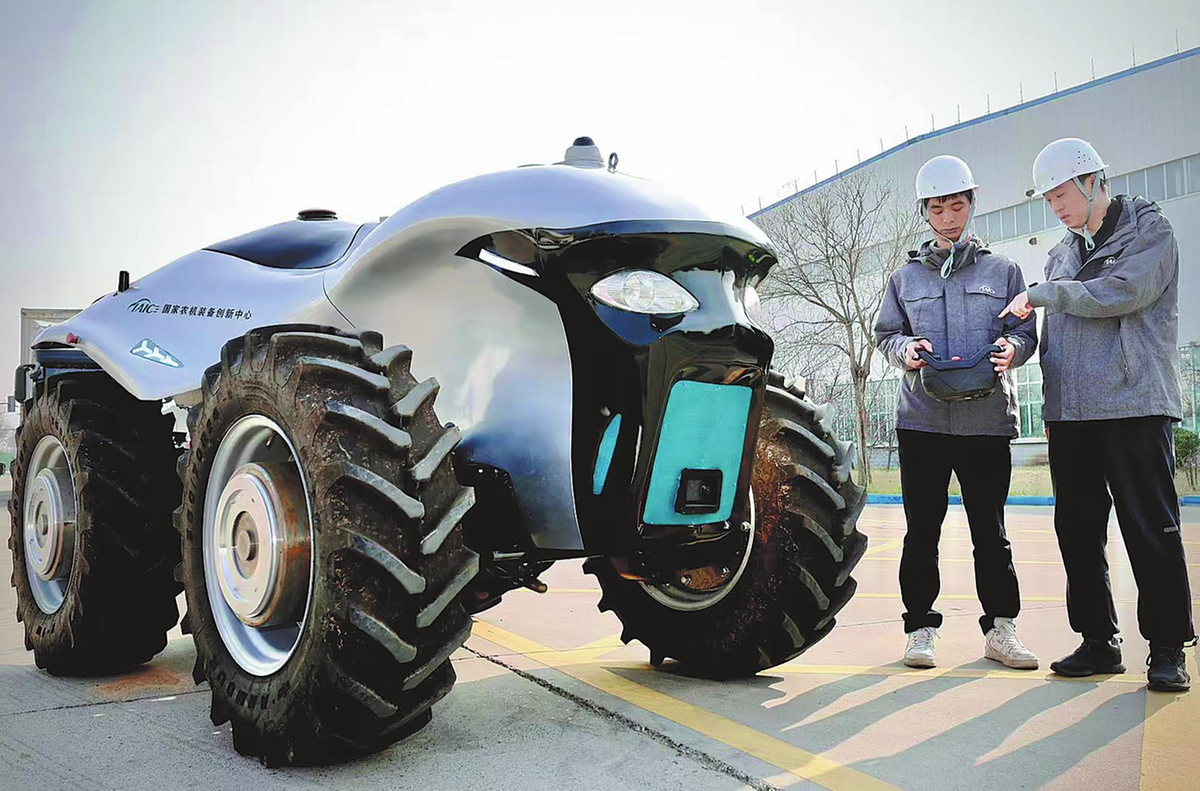
 An autonomous tractor developed by the National Agricultural Machinery Equipment Innovation Center in Luoyang, Henan province. CHINA DAILY
The hardest part was getting into the tractor. A narrow ladder led to a cab perched nearly three meters above the ground. By the time I settled into the driver's seat, the surroundings looked noticeably smaller below. I expected something industrial and intimidating. Instead, the cabin felt surprisingly familiar.
There were two seats, a panoramic windshield and a digital instrument panel. Where I expected to find a row of heavy gear levers sat a single automotive-style joystick.
"Just push it forward," the engineer beside me said.
A gentle nudge was all it took.
The 450-horsepower tractor rolled ahead almost effortlessly. Despite weighing several metric tons, there was no jolt as gears shifted — because there were no gears to shift. It doesn't require gear changes to go backward either. The giant machine accelerated with remarkable smoothness, responding almost like an SUV rather than a traditional piece of agricultural equipment.
For a first-time driver, the experience was unexpectedly easy.
That smooth ride comes from a technology known as a continuously variable transmission, one of the most technically demanding components in modern agricultural machinery.
Unlike conventional gearboxes, a CVT continuously adjusts power delivery without changing gears, allowing tractors to maintain optimal engine speed as field conditions change. The result is smoother operation, lower fuel consumption and greater precision during planting and tillage.
For farmers, however, the biggest advantage isn't mechanical sophistication. It's economics. By keeping the engine operating at its most efficient speed, the tractor allows farmers to cover more acreage in a day while consuming less diesel.
"If farmers can finish more work in a day, their revenue goes up. If they burn less fuel, their costs come down," said Li Weiqi, brand management manager at YTO Group, China's largest tractor manufacturer. "Higher income on one side and lower costs on the other — that difference becomes the farmer's additional profit."
The simplified controls also lower the learning curve for operators, making high-horsepower tractors easier to use for a younger generation of farmers who are increasingly expected to manage larger farms with fewer workers.
For YTO, the technology represents something much bigger than an easier driving experience.
Only a few years ago, Chinese manufacturers largely depended on foreign suppliers for advanced transmission systems like CVT. Developing the technology in-house marks an important milestone in YTO's efforts to move beyond competing primarily on price and into the premium end of the global agricultural machinery market.
That ambition is visible throughout YTO's flagship factory in Luoyang, Henan province.
Robotic welding arms shower sparks across the production line. Automated guided vehicles shuttle engines between workstations. Digital manufacturing systems monitor every stage of production as one tractor after another moves steadily toward final assembly. The factory can produce as many as 45,000 large tractors a year.
"We don't simply want to manufacture more tractors," said Su Wensheng, vice-general manager of YTO. "Our goal is to build a globally competitive brand."
For decades, China's manufacturers built one of the world's largest farm equipment industries by producing reliable, affordable machinery for domestic farmers. Today, they are pursuing a more difficult objective: convincing customers around the world that Chinese-made agricultural equipment can compete not only on cost, but also on technology, reliability and innovation.
China's latest development plan for the agricultural machinery industry calls for raising the domestic content of core high-end components to 90 percent by 2030 while building a smarter and more globally competitive manufacturing base.
YTO is already looking beyond mechanical engineering. The company is integrating artificial intelligence, remote diagnostics and real-time data monitoring into its newest machines, allowing operators to monitor equipment remotely, identify mechanical problems before failures occur and optimize field operations.
The next breakthrough may require no driver at all. Using the country's BeiDou satellite navigation system, YTO has developed autonomous tractor systems that are already being tested on large farms in Heilongjiang province. The machines can perform tillage and planting with minimal human intervention. Moving from demonstration projects to large-scale commercial adoption, however, will take years, Su said.
Foreign markets are becoming increasingly important as China's domestic agricultural machinery market matures. The company now exports tractors to more than 100 countries and regions. Tractor exports rose 47 percent year-on-year in the first half to more than 8,000 units, driven largely by demand across Asia and the Americas. YTO expects overseas shipments to reach roughly 15,000 units this year, about 50 percent more than last year.
The progress is beginning to show in export figures.
China's agricultural machinery exports reached 39.45 billion yuan ($5.88 billion) in the first half, up 12.7 percent from a year earlier. Tractor exports climbed 16 percent to 104,500 units, while export value rose 23.6 percent to 5.38 billion yuan.
The race to build higher-end agricultural machinery extends well beyond tractors.
About 200 kilometers east of Luoyang, inside a factory in Zhengzhou, workers are preparing a giant hydraulic reversible plow for shipment overseas.
Capable of turning a swath of soil about 6.5 meters wide in a single pass, the 13-bottom hydraulic reversible plow has become one of Zhengzhou Zhongxing Longfeng Agricultural Machinery Equipment's flagship export products.
Until recently, equipment of this size was largely supplied by European manufacturers.
Longfeng didn't originally intend to develop everything itself. More than a decade ago, the company sought technology partnerships with European manufacturers, hoping to cooperate on manufacturing processes and product development. The discussions ultimately went nowhere.
"That was when we realized we had to master the core technologies ourselves," said Hai Zhiyong, a company director.
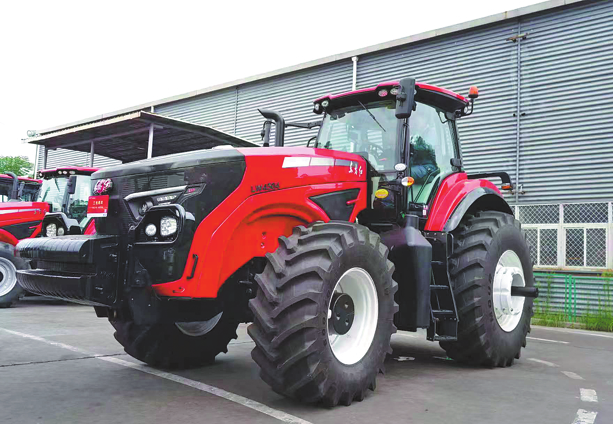
A 450-horsepower tractor developed by YTO Group Corp in Luoyang, Henan province. CHINA DAILY
The setback fundamentally changed Longfeng's strategy.
Today, the company invests between 5 percent and 10 percent of its annual revenue into research and development, while roughly 15 percent of its employees work in R&D. It has accumulated more than 100 patents, operates proprietary testing platforms and designs much of its own production equipment.
"It took us more than 30 years to go from three-bottom models to thirteen-bottom models, and from relying on imported components to mastering core technologies ourselves," said Chen Xuanda, the company's R&D manager.
Plows are becoming increasingly intelligent. Mechanical controls are gradually giving way to hydraulic systems, electronic controls and satellite navigation.
Longfeng's newest models can automatically adjust working width and detect obstacles, reducing the need for operators to repeatedly climb out of the tractor to make manual adjustments.
"In the future, machinery must not only be highly productive, but also smarter and more precise," Chen said.
Its first major overseas breakthrough came five years ago through exports to Russia, whose vast farmland created demand for large hydraulic plows.
"Customers care first about quality, then after-sales service, and only then about price," Chen said.
Today, overseas business contributes roughly one-quarter of Longfeng's revenue, and the company hopes eventually to raise that figure to between 50 percent and 60 percent.
Different regions require different products. Smaller machines are shipped to Southeast Asia, where farmland is relatively fragmented. Russia and other large-scale agricultural markets purchase customized 12-bottom and 13-bottom plows designed for industrial farming.
For Hai, exporting machinery is only the beginning.
"To truly succeed internationally, you need localized sales and service networks," he said. "That's what we're building now."

