
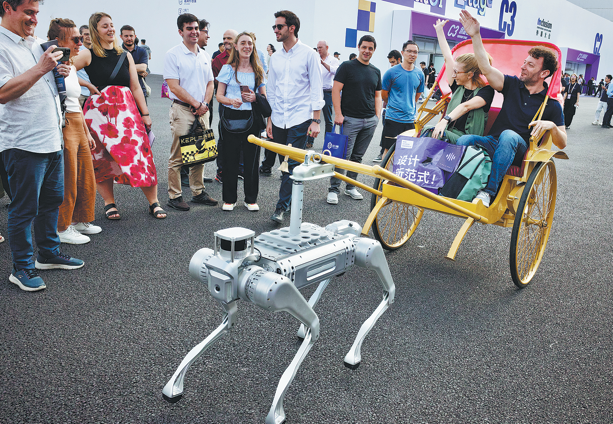
A robot dog styled as a rickshaw puller takes tourists for a spin during the 2026 Inclusion Conference on the Bund in Shanghai on Sept 9. This year's conference was themed "Building the AI Economy Together." GAO ERQIANG/CHINA DAILY
Chinese and European representatives have called for stronger cross-border cooperation on artificial intelligence governance at the 21st Meeting of China-EU Round Table in Hangzhou, Zhejiang province, saying no country can manage AI risks alone.
Representatives discussed how to promote AI that is safe, reliable and centered on people, while addressing the potential impact of the rapidly developing technology on employment and society.
The round table is jointly organized by the China Economic and Social Council and the European Economic and Social Committee.
Vasco De Mello, a member of the Employers' Group of the EESC and vice-president of the Commerce and Services Confederation of Portugal, said AI could significantly increase productivity and production capacity, but its rapid development also required greater attention to potential risks.
"These risks are cross-border, and no country can tackle them alone or simply close its borders to manage and govern them, because data is fluid and crosses borders," De Mello said.
Miao Wei, a member of the Committee on Economic Affairs of the National Committee of the Chinese People's Political Consultative Conference, also called for stronger international coordination on AI safety and governance.
In a keynote report titled "Advancing AI Development for the Well-being of People Worldwide", Miao called for more research into AI safety risks and ethical concerns, as well as governance covering the entire process from data collection and algorithms to AI applications.
He also urged countries to strengthen cooperation in law enforcement to combat transnational crimes involving AI and work together to make the technology safer, more reliable and easier to control.
Participants said AI governance should go beyond technical safeguards and pay greater attention to the technology's effects on workers and society.
Lu Yi, a member of the CESC and director of the Tsinghua China Data Center, said the impact of AI on employment should be considered alongside broader changes in the global economy, industrial and supply chains as well as demographic trends.
"One basic feature of technological progress is that its benefits are broadly distributed, while its costs are concentrated among specific groups," Lu said.
He called for stronger systems to redistribute resources and expand social welfare to help workers who lose their jobs or face reduced employment opportunities because of technological change.
Luka Bogdan, a member of the Civil Society Organisations Group of the EESC, said it was also essential to ensure that people remain in control of AI systems.
"If AI gets out of control, the consequences would be immeasurable and very difficult to manage," Bogdan said. He called for better education, stronger labor protections and people-centered policies to reduce the risks of misuse.
Participants also highlighted several areas where China and the EU could expand practical cooperation.
Denis Jeambrun, a member of the Workers' Group of the EESC and federal secretary for aerospace and defense at the French Democratic Confederation of Labour, said cooperation should focus on challenges shared by both sides, including population aging, labor shortages and growing demand for AI applications.
"Both regions have solid technological and scientific foundations, and we can help each other," Jeambrun said.
She identified basic research, chip production, advanced robotics and technologies that serve elderly people and people with disabilities as potential areas for cooperation.
Xu Xiaolan, a member of the Standing Committee of the National Committee of the CPPCC and chairperson of the Chinese Institute of Electronics, said China and the EU also share common ground in promoting cooperation among countries on AI governance.
"China and the EU are both staunch defenders of multilateralism and important forces in global AI governance, and we share broad consensus on advancing AI governance," Xu said.
She said the two sides could also work together to help developing countries strengthen their AI capabilities through technology transfer and talent development, contributing to a fair and nondiscriminatory global system for governing digital technologies.

