
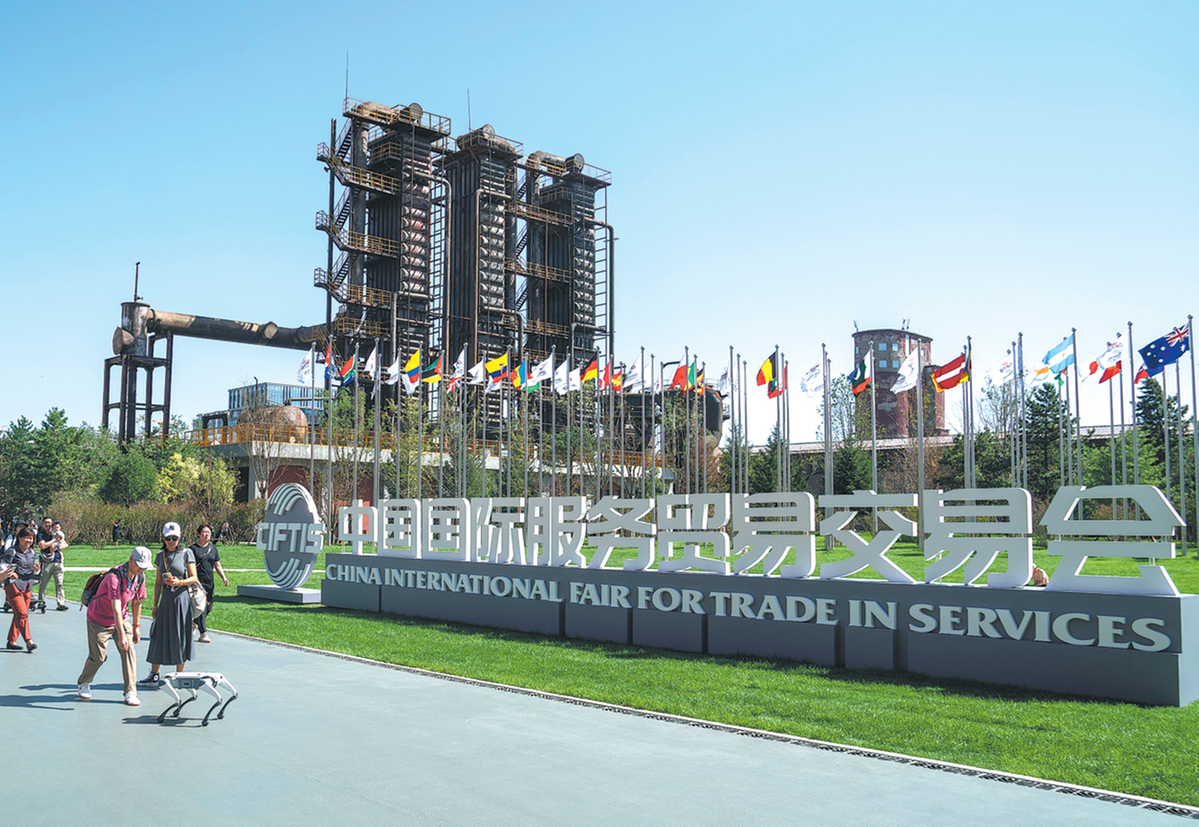
Visitors interact with a robot dog during the 2025 China International Fair for Trade in Services in Beijing on Sept 14. DING HE/XINHUA
China's trade in services saw rapid expansion in the first half, officials, experts and business executives said, pointing to a shift toward a foreign trade structure in which services are an increasingly important source of growth.
Buoyed by the sector's robust expansion, the China International Fair for Trade in Services is set to further cement its role as a two-way gateway, accelerating the flow of global innovation into China's vast market while helping Chinese service providers make further inroads in markets overseas.
Opening in Beijing on Wednesday, the five-day fair is expected to draw growing international attention, underscoring China's commitment to opening its services sector wider and injecting much-needed stability and certainty into global trade amid mounting protectionism and heightened economic uncertainty, they added.
In contrast to goods trade, which involves physical products moving across borders, services trade covers transactions in intangible offerings ranging from transportation and tourism to telecommunications, advertising, education, computing and accounting.
In the first half, China's imports and exports of services totaled 3.78 trillion yuan ($556.6 billion), up 8.3 percent year-on-year, said the Ministry of Commerce.
That was nearly 50 percent higher than in the same period a decade earlier, when the total stood at 2.53 trillion yuan. Growth has gathered pace in recent years, with annual two-way services trade topping $1 trillion for the first time in 2024, the ministry said.
"China's services trade is expanding rapidly and becoming more competitive. It has emerged as a particularly resilient source of growth in the country's opening-up drive," said Wang Peng, a researcher at the Beijing Academy of Social Sciences.
That growing strength is drawing businesses from around the world, with a strong international presence expected at the event.
"This year's fair will bring together some 90 countries and international organizations, with more than 1,800 companies set to exhibit on-site," Vice-Minister of Commerce Yan Dong said at a recent news conference in Beijing.
Falkor, a Norway-based industrial intelligence provider serving the global energy sector, will make its fifth appearance at CIFTIS this year, showcasing its solutions, real-world applications and the results of its work with industry partners, said Wu Haifeng, senior vice-president of Falkor.
Norway will serve as the guest country of honor at this year's fair. Wu, who is also vice-chairman of the Norwegian Business Association China, said Norwegian businesses hope to use the occasion to forge new partnerships in China.
At last year's fair, the company formed a strategic partnership with China Oil HBP Science & Technology Co. The two sides have since been working to roll out an industrial digital platform, Wu said.
"Over the next five years, we will continue to increase our investment in China, deepen local partnerships, and use industrial intelligence to boost operational performance and advance the energy sector's green transition," Wu said.
Meanwhile, this year's fair will see more than 90 companies and institutions unveil new technologies, products and services spanning information and communications technology, fintech and digital healthcare, with some set for global debuts or their first showings in China, Yan added.
Johnson & Johnson MedTech, the medical technology arm of US healthcare giant Johnson & Johnson, will bring more than 60 products to the fair. About one-third will make their CIFTIS debut, said Edward Zhou, president of Johnson& Johnson MedTech China.
"We have been part of CIFTIS for several years now, and what sets this platform apart is its ability to turn conversations into action. It is more than a showcase — it is a catalyst," Zhou said.
Impella, a minimally invasive heart pump featured at last year's fair, has since secured temporary import approval under a program for innovative medical devices needed in clinical care and entered clinical use at leading cardiac centers in Beijing, he said, adding that "what we see in China's services trade is a clear shift toward quality-driven growth".
China's services exports jumped 17.6 percent year-on-year to 1.5 trillion yuan in the first half. Exports of knowledge-intensive services rose 12.8 percent to 805.67 billion yuan, making up 53.5 percent of all services exports, said the Ministry of Commerce.

Visitors check out exhibits during the 2025 CIFTIS in Beijing on Sept 14. The 2026 CIFTIS will start in the city on Wednesday and run through Sunday. SUI SHANGJUN/XINHUA
"With knowledge-intensive services now accounting for more than half of China's services exports, the sector has reached an inflection point and is moving further up the value chain," said Bai Wenxi, vice-chairman of the China Enterprise Capital Union.
Digital technology and artificial intelligence are accelerating the shift, with digital services emerging as a new growth engine, Bai said.
Zhou Mi, a senior researcher at the Chinese Academy of International Trade and Economic Cooperation, also struck an optimistic note, saying China's rapid advances in AI and steady improvements in intellectual property protections would give its services exports ample room to grow.
Travel service exports grew even faster, rising 31.1 percent year-on-year to 229.2 billion yuan in the first half, the fastest pace among the five largest service export categories, said the ministry.
The surge came as China expanded visa-free access, streamlined departure tax refunds and improved payment services, fueling the popularity of "China Travel", Yan said.
China is doubling down on services exports, with "encouraging and supporting services exports" embedded in this year's Government Work Report as a key task.
In April, the State Council — the nation's Cabinet — issued a new set of guidelines aimed at expanding capacity and upgrading the quality of the country's services sector, setting a goal for its total scale to reach 100 trillion yuan by 2030.
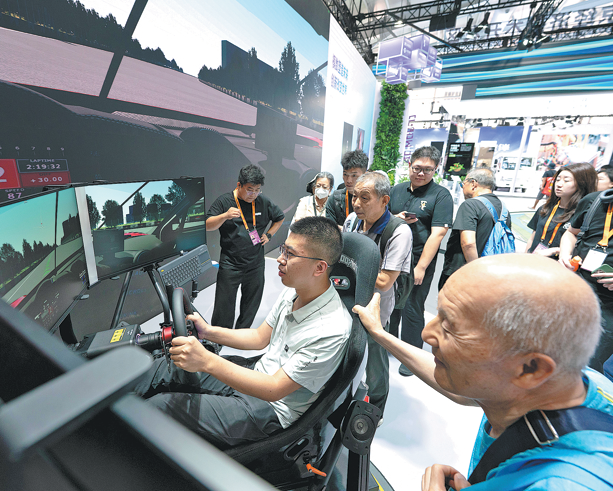
An image captures a visitor trying out a racing simulation software during the 2025 CIFTIS in Beijing on Sept 14. XIE HAN/XINHUA
Yan said the policy push would gather pace in the second half as measures to expand and upgrade the services sector and build national demonstration zones for the innovative development of trade in services take effect.
A State Council report submitted to the Standing Committee of the National People's Congress for review in late August also called for expanding trade in services and promoting more balanced trade in the second half.
"China's trade in services is expected to remain on a positive trajectory this year, with services exports continuing to grow strongly," Yan said.
To further strengthen the competitiveness of Chinese services in foreign markets, this year's fair will, for the first time, feature a promotion and roadshow zone for overseas-expansion services, said Tang Wenhong, vice-mayor of Beijing, at the news conference.
Stronger exports have also helped narrow China's services trade deficit. The gap stood at 770.35 billion yuan in the first half, 161.42 billion yuan less than a year earlier, official figures showed.
Yet experts said the remaining gap points to room for the country to strengthen its competitiveness in high-value services.
Bai pointed to market access barriers, regional imbalances and gaps in domestic supply.
Trade in services remains concentrated in eastern China, with central and western regions playing a smaller role. Domestic supply remains weak in some knowledge-intensive areas, particularly intellectual property-related services, he said.
Bai called for closer alignment with international rules on digital services trade and sustained policy support for inbound tourism.
"China needs to make better use of CIFTIS, build stronger capabilities in knowledge-intensive services and move faster on institutional opening-up," he said.
The ministry said China will move faster to develop national demonstration zones for the innovative development of trade in services. The country will also steadily broaden market access and open up more areas of the services sector, while improving the negative-list system for cross-border trade in services.
The measures are aimed at removing barriers and creating a more open, transparent and predictable market environment for domestic and foreign businesses.
Zhou from the academy said the deficit should not be viewed in isolation.
While an excessively large gap could make it harder to build strong industry clusters and sharpen competitiveness, imports can bring in the expertise and technology needed for economic upgrading, he said.
As China's domestic capabilities strengthen, services exports are also rising, Zhou said, adding: "China should expand services imports and exports in tandem and tap global expertise and resources to add momentum to growth. That would make the economy more knowledge — and technology-intensive and support high-quality development."

