
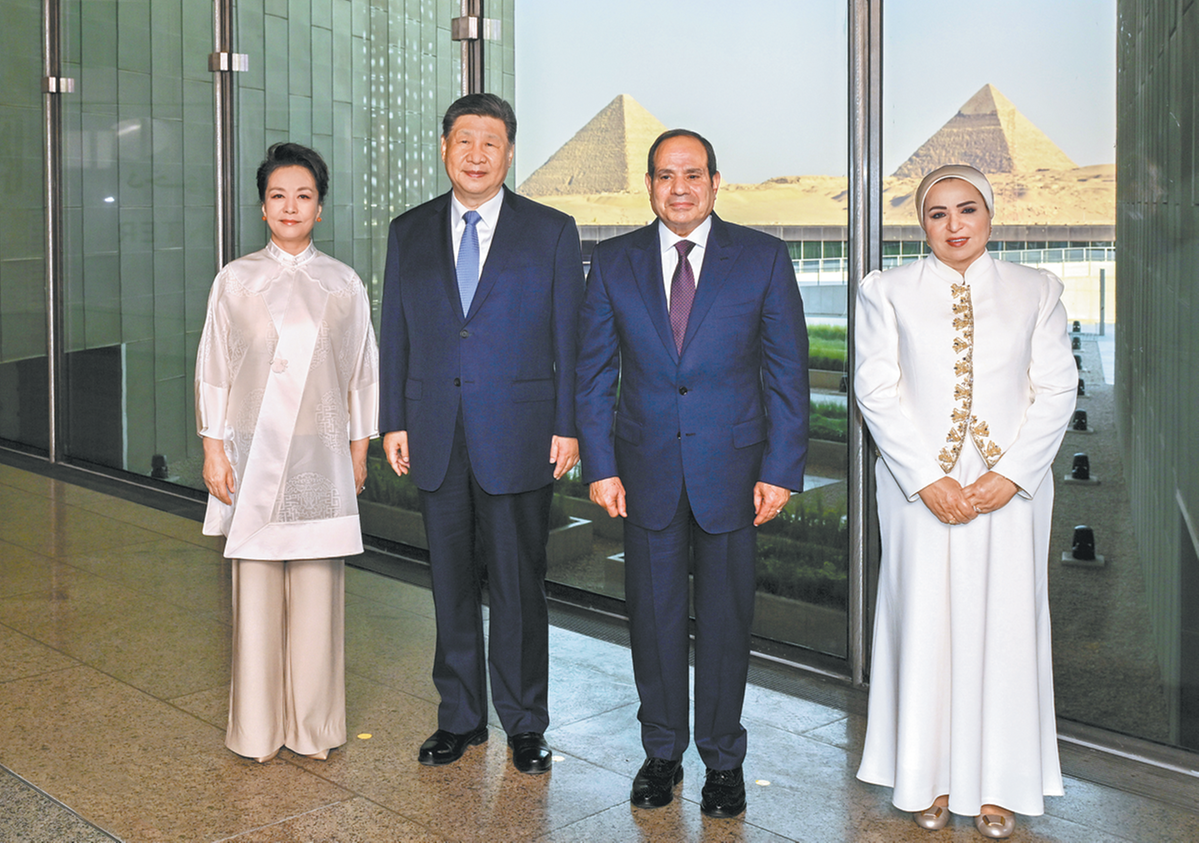
 President Xi Jinping and his wife, Peng Liyuan, pose for a photo with Egyptian President Abdel Fattah El-Sisi and his wife, Entissar El-Sisi, while touring the Grand Egyptian Museum in Giza, Egypt, on Wednesday. XIE HUANCHI/XINHUA
CAIRO -- On the Giza Plateau, the majestic pyramids, silent witnesses to millennia of history, now gaze across at the Grand Egyptian Museum.
Chinese President Xi Jinping and his wife, Peng Liyuan, visited the museum on Wednesday during his state visit to Egypt, where they were warmly received by Egyptian President Abdel Fattah El-Sisi and his wife.
Surrounded by ancient artifacts, the two presidential couples toured the grand galleries, posing for a photo before a towering statue of Ramses II, one of the most famous pharaohs of Egypt, as curators delivered a swift primer on pharaonic history.
"This museum is a book with endless pages," Xi said.
He, during the tour, also urged the two countries to promote the inclusive coexistence and mutual learning among different civilizations, and pool greater strength from civilizations to advance the building of a community with a shared future for humanity.
As the world's largest museum dedicated to a single civilization, the Grand Egyptian Museum houses more than 100,000 precious artifacts. Locals have newly dubbed it the "fourth pyramid of Giza."
The Grand Egyptian Museum is just one of the many museums Xi has visited over the years. Whether on domestic inspection tours or overseas trips, his visits have taken him to the Sanxingdui Museum in southwest China's Sichuan province and the Yinxu Museum in central China's Henan province, key sites of early Chinese civilization, as well as the Amir Timur Museum in Uzbekistan, and the ancient Maya ruins of Chichen Itza in Mexico. The list goes on.
Such frequent museum visits stem from Xi's longstanding emphasis on preserving and carrying forward traditional culture. For Xi, museums are important places that protect and pass on human civilizations.
In November 2019, during his visit to the Acropolis Museum in Athens, Greece, Xi paused to admire the relief of the "Pensive Athena," the Greek goddess of war and wisdom. He and then Greek President Prokopis Pavlopoulos explored how ancient Chinese and Greek civilizations expressed their reflections on war and their shared longing for peace.
Museums have also been a frequent choice for Xi to present traditional Chinese culture when hosting foreign dignitaries.
During US President Donald Trump's two visits to China in 2017 and 2026, Xi hosted him at the Forbidden City, or the Palace Museum, and the Temple of Heaven, respectively, using the historic sites to illustrate the Chinese philosophy of pursuing peace and harmony.
In Xi's eyes, museums are not simply repositories of the past. They offer people a chance to discover unfamiliar histories, recognize common threads of human creativity and gain a deeper understanding of one another.
During his first state visit to Egypt in 2016, Xi toured Luxor, a city widely known as one of the world's largest open-air museums. Walking along the main avenue of Luxor Temple, Xi and Sisi discussed the distinctive features of their two ancient civilizations, recalling their long history of exchanges and mutual learning. At the temple, they also witnessed the launch of the 2016 China-Egypt Culture Year, a landmark moment in bilateral cultural exchanges.
Today, the Grand Egyptian Museum provides a new setting for that dialogue between the two ancient civilizations. In a message to Sisi on its opening last year, Xi said that the museum will leave a profound mark on Egypt's cultural history and play an important role in preserving and passing on the ancient Egyptian civilization.
It is encouraging to see the two ancient civilizations reaching out to each other, with the two peoples growing ever closer through mutual understanding and affinity, Xi said in the message.
From Beijing to Cairo, Xi's museum visits underscore how history can bridge rather than divide civilizations, enabling them to deepen mutual understanding and draw on the wisdom of the past to shape the road ahead.
As Xi has observed, "Museums bridge the past, present, and future."

