
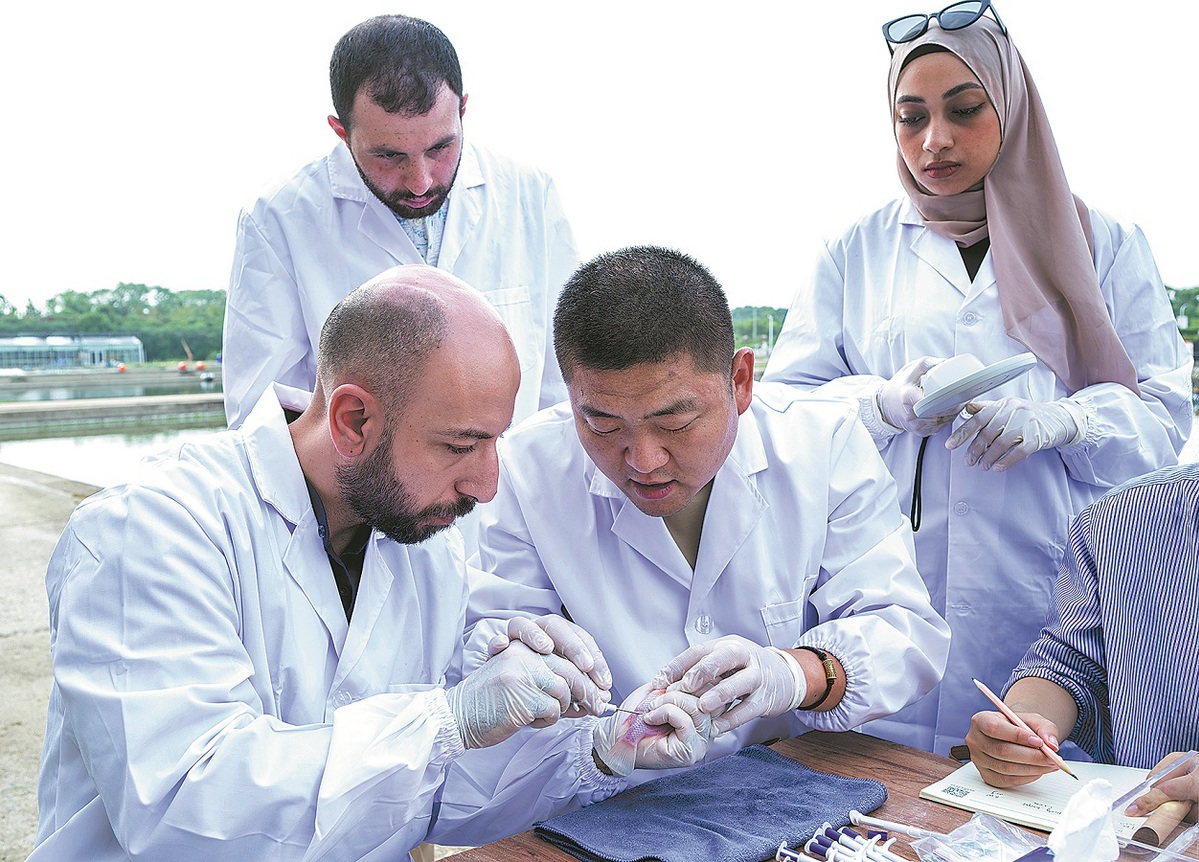
Chinese and Egyptian scientists work together to collect DNA samples from a tilapia in Wuxi, Jiangsu province. [Photo provided to CHINA DAILY]
A China-Egypt research partnership has developed a new tilapia variety that combines greater salinity tolerance with faster growth, marking a critical step in the two countries' cooperation on aquaculture technology and genetic improvement.
The project, jointly conducted by the Freshwater Fisheries Research Center of the Chinese Academy of Fishery Sciences and Suez Canal University, is aimed at making better use of Egypt's brackish-water resources while improving the productivity and sustainability of tilapia farming.
Egypt is one of the world's largest tilapia producers, and the fish is an important source of food and income for the country. However, much of its production relies on freshwater, while salinity in some coastal and desert farming areas is increasing.
"Coastal areas and desert farms struggle with progressive soil salinization and increasing water salinity," said Mohamed Fekri, an associate professor at Suez Canal University's Fish Farming and Technology Institute and an Egyptian researcher involved in the project.
The challenge has highlighted the need for varieties that can perform well under local conditions. Most commercial Egyptian farms rely on standard Nile tilapia, which is better suited to freshwater, Fekri said.
The joint project grew out of a relationship that has developed over more than a decade.
Qiang Jun, director of scientific research at the Freshwater Fisheries Research Center, said cooperation between the two institutions dates back to 2009. Through years of collaboration, researchers identified complementary strengths and a shared research opportunity.
"Egypt has abundant brackish-water resources, but because of the lack of salt-tolerant varieties, these resources have not been effectively utilized," Qiang said.
At the same time, Chinese researchers had accumulated experience in tilapia genetic improvement and had successfully developed five new tilapia varieties. Therefore the two sides decided to combine Egypt's local resources and knowledge with China's expertise in molecular breeding.
"We are not simply transplanting Chinese technology to Egypt," Qiang said. "The new salt-tolerant variety is being tested in Egypt's local brackish-water farming areas so that its production performance can be verified under real conditions."
The cooperation began with a survey of Egypt's tilapia genetic resources. The research teams examined nine tilapia farming populations in major brackish-water areas and identified three varieties newly found in Port Said, located in northeastern Egypt on the Mediterranean coast, that showed rich genetic diversity and potential as breeding materials.
The teams then combined genetic-resource screening with genomic technologies. Chinese researchers used genome-wide association studies, or GWAS, to identify key markers associated with salinity tolerance and rapid growth.
That work has resulted in a salt-tolerant red tilapia variety now in its third generation of selection.
When tested at salinities of 15 to 20 parts per thousand, the new variety recorded an average body weight 25.1 percent higher than that of unselected populations. Its survival rate increased from 74.1 percent to 87.7 percent.
Joint teams have visited aquaculture facilities in both countries to collect data, test technologies and provide technical support. "We package technology, varieties and standards together," Qiang said. "Combined with systematic training for local technicians and farmers, this can help integrate the technology and standards into local production."
The project has also guided four Egyptian graduate students, two of whom have continued their doctoral studies in China. In Egypt, the partners have trained 20 fish farmers and provided 475 times of training of technicians on water-quality management, seed production and disease prevention.
Apart from developing new varieties, the project aims to develop broodstock resources and breeding systems in Egypt to establish a stronger local breeding capacity.
The two sides are also looking to expand their cooperation beyond selective breeding. Qiang said Chinese researchers are exploring the application of recirculating aquaculture system technology in Egypt, with studies focusing on how the technology can be adapted to local climate and resource conditions.
The partners also plan to seek a joint laboratory for the conservation, development and utilization of tilapia genetic resources in the Nile River basin. Future cooperation could extend to marine aquaculture, smart hatcheries and localized production of aquaculture equipment and inputs, Fekri said.
"Ultimately, China-Egypt cooperation acts as a technological accelerator, transforming Egypt's conventional semi-intensive farming into a smart, sustainable aquaculture industry capable of securing food security and enhancing global export competitiveness," he said.

