
"Hi, my name is Li Bai," Leonid Mitrofanov often tells Chinese visitors as he prepares to lead them through the boulevards of his hometown, Bishkek, the capital of Kyrgyzstan. For the tourists, this introduction by the Chinese-speaking tour guide is a delightfully memorable icebreaker.
Mitrofanov, 28, took a liking to poetry when he was young, and his life took a decided turn when he was 16 and took up Chinese studies in Zhengzhou, Henan province. After more than three years, he gained a solid command of the language.
It was after gaining fluency that his literary curiosity led him to classical poetry, specifically the works of his namesake Li Bai (701-762), one of ancient China's most revered poets.
After learning that the poet was said to have been born in the ancient city of Suyab, near present-day Tokmok in Kyrgyzstan and just a short drive from Bishkek, Mitrofanov adopted the moniker as his own.
"Li Bai is far more than a fun Chinese name for me," Mitrofanov says. "It's a cultural symbol that bridges my life today in Bishkek with my student years in Zhengzhou, symbolizing the deep bond between Kyrgyzstan and China."
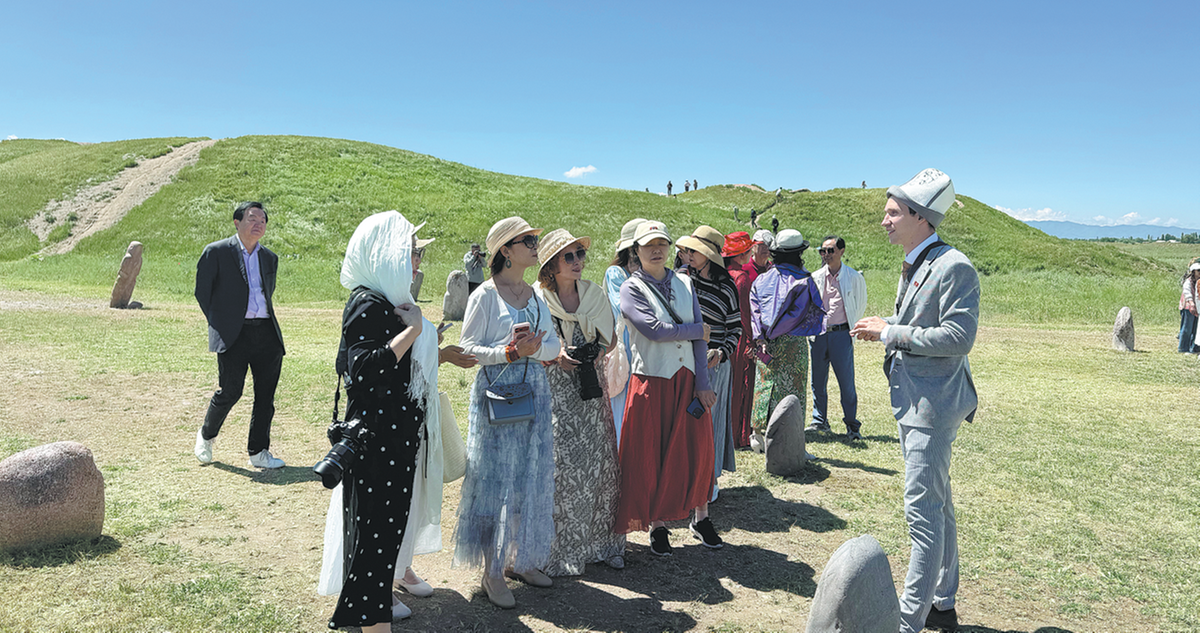
Leonid Mitrofanov introduces Tokmok to Chinese visitors as a tour guide. CHINA DAILY
On May 28, Zhengzhou and Bishkek established sister-city relations. The agreement developed their ties into a comprehensive partnership, bridging aspects of urban life — from consumer goods and public transportation to education — into a framework for mutual growth.
Lu Kang, president of the Henan Chamber of Commerce in Kyrgyzstan, who has lived in Bishkek for nearly 30 years, says he has felt ties between Henan and Kyrgyzstan have grown even closer through the Belt and Road Initiative, which was proposed in 2013.
"Walking through the streets of Bishkek today, you can feel a Henan touch. You can enjoy Henan huimian (braised noodles) and hulatang (spicy soup), and Henan-made instant noodles have entered local supermarkets and convenience stores, becoming everyday consumer goods for locals."
For Mitrofanov, Henan's presence in Bishkek brought back memories of his years in Zhengzhou. During his studies, he grew fond of the city's ubiquitous milk tea spots. He relived those memories in June when the Zhengzhou beverage chain Mixue Bingcheng opened outlets in Bishkek.
After stopping by one of the new, bustling outlets to try the brand's signature soft serve ice cream, Mitrofanov recognized the familiar flavor immediately.
"Now I can taste Zhengzhou right here in Bishkek," he said, adding an enthusiastic "Zhong! Zhong! Zhong!" — meaning "terrific" in Henan dialect.
Economic and trade collaboration between China and Kyrgyzstan is thriving, something reflected in daily life in Bishkek and beyond, says Rashid Yusupov, director of the Belt and Road Research Center of Kyrgyz National University for Nationalities in Bishkek.
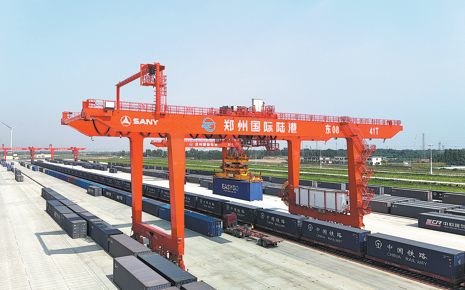
A view of Zhengzhou International Land Port in Henan province. CHINA DAILY
The arrival of Chinese beverage brands in Bishkek, for example, has done more than just enrich consumer choices, he says. "It also drives the development of the service industry and fosters the growth of a modern urban consumer culture."
Beyond daily consumer culture, Henan's presence in Bishkek is visible along the capital's busy transport arteries.
As a tour guide, Mitrofanov frequently travels the city's roads. "When I take tour groups around the city, I'm constantly on buses. Over time something dawned on me: most of Bishkek's buses, as well as the tour coaches we rely on, come from one firm — Yutong Bus of Zhengzhou."
Yutong entered Kyrgyzstan in 2019, where it now has a fleet of more than 350 vehicles. As of July, Yutong buses account for more than 65 percent of public buses in Bishkek, says Shan Yao, account manager for Central Asia at Yutong Bus. Diesel and compressed natural gas models dominate the fleet, but small-batch trials of electric buses have already begun.
"Kyrgyzstan is a key market in our Central Asia strategy," Shan says. "Its mountainous terrain and extreme climate place extraordinarily high demands on vehicle reliability. Buses that perform well here give us even greater confidence in other markets."
Yusupov says Chinese technology and enterprises are increasingly woven into daily life in Bishkek, spanning service sectors, infrastructure and logistics.
Economic agreements deliver practical benefits, but human connection forms the true foundation of long-term collaboration, he says, noting that thousands of Kyrgyzstanis are now studying in China, including in Zhengzhou.
Among them is Bekzat Tashbolotov, 19, from Bishkek, who is studying at Zhengzhou University of Industrial Technology. Tashbolotov, encouraged by a friend's firsthand experience, found an engaging academic environment with attentive teachers who tailor their lectures to ensure international students can thoroughly understand and master the material.
For Tashbolotov, mastering Mandarin is central to his long-term goal.
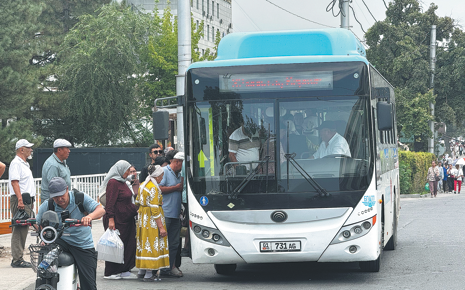
Passengers in Bishkek board a Yutong bus during their daily commute on Aug 7. WANG YANG/FOR CHINA DAILY
Bridge for communication
"I know language is the bridge for cross-border communication. I hope eventually to work in Kyrgyz-Chinese translation, business liaison and people-to-people exchanges, drawing on my strengths to build a communication bridge and serve as a youth ambassador for bilateral friendship."
Tashbolotov describes Zhengzhou as an inclusive and vibrant city steeped in thousands of years of history. It has also offered an unexpected personal connection, he said.
"After arriving in Zhengzhou, I was surprised to learn that the Yutong buses I used every day to commute back home were made right here in the city where I study."
Dong Pengfei, associate dean of the School of International Education at Zhengzhou University of Industrial Technology, who oversees international student administration and exchanges, views youth dialogue as the most fundamental and enduring tie between countries.
The university works closely with Kyrgyz higher education institutions on degree programs, joint research and two-way cultural exchanges, Dong said.
"Kyrgyz students come to China to experience its development and deepen their professional knowledge, and our faculty and students travel to Kyrgyzstan to share Chinese culture and understand Central Asia. This interaction fosters deep dialogue, cultural identity and emotional ties between young people of both countries," Dong added.

Young people in Kyrgyzstan and China have far more opportunities for communication, study and cooperation than previous generations, Yusupov says.
Lu of the Henan Chamber of Commerce in Kyrgyzstan says that under the Belt and Road Initiative, Henan and Kyrgyzstan have deepened their ties and worked together for a China-Central Asia community with a shared future.
"Zhengzhou, as a national transportation hub and an inland gateway for opening-up, and Bishkek, as a pivotal city in Central Asia, complement each other and foster mutual empowerment in the framework of the Shanghai Cooperation Organization," he said.
"I hope that within the SCO framework, highly fruitful ties between Zhengzhou and Bishkek continue to strengthen, allowing more Henan brands and China's Central Plains culture to take root in Central Asia."
Mitrofanov said: "I feel a deep bond with Henan and the people of Zhengzhou. I hope more young people study in China, and more Chinese come here to explore business. That exchange is how we truly get to know each other."

