
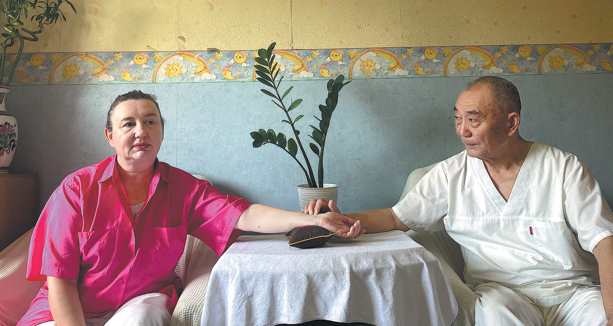
Traditional Chinese medicine practitioner Chang Guanglin (right) checks the pulse of a patient in Bishkek, Kyrgyzstan, in August. CHINA DAILY
Chinara Kaparova regarded herself as being fairly familiar with traditional Chinese medicine and open-minded about it, but she said she nevertheless nursed a fear about some of its procedures.
The pediatric neurologist, 59, in Bishkek certainly appreciated its value, having studied TCM in Beijing for a month several years ago. Yet when it came to her own ailments — headaches, high blood pressure, insomnia and icy feet that dragged down her quality of life — she hesitated. It was only after her sons, who had received effective treatment from a TCM practitioner, urged her to visit him that she decided to take that step.
Through a tailored regimen of acupuncture, massage and cupping, along with lifestyle advice — going on walks outdoors and eating more fresh produce — her health began to steadily recover, she said. To be sure, there was no miraculous overnight cure, just a palpable, dayby-day return of her vitality.
"TCM is a unique, highly individualized treatment in the hands of true professionals, a treasure the Chinese people can be proud of," Kaparova said.
Her experience reflects a growing openness to traditional Chinese medicine in Kyrgyzstan, and practitioners such as Chang Guanglin, who treated Kaparova, are making these traditional therapies more accessible than ever.
Chang's journey abroad was deeply rooted in his youth. Raised and educated in Zhengzhou, Henan province, he mastered Russian during his secondary school years. After studying traditional Chinese medicine at Henan University of Chinese Medicine, he practiced domestically for years before taking up postings in Europe and Central Asia, until he retired in 2008.
"Studying in Zhengzhou cemented my Russian-language skills and fueled my devotion to TCM, sealing it as my lifelong vocation," Chang said. "Zhengzhou is the place that is dearest to me, and to which I owe a debt of gratitude.
"However, when I retired, I felt my mission as a doctor remained unfinished. Taking TCM to Central Asia was not just about treating patients but also about building cultural bridges and friendship across countries involved in the Belt and Road Initiative."
Drawn by Kyrgyzstan's temperate climate, cuisine and the warmth of its people, he traveled to Bishkek in 2015 to open a practice, eventually founding the Zhongjing Traditional Chinese Medicine Research Institute, named after Zhang Zhongjing, a pharmacologist, physician of the Eastern Han Dynasty (25-220) and native of Henan.
"Since 2015 I've watched our patient base grow steadily as more locals welcome TCM's approach to wellness," Chang said.
"We don't do any advertising. Our patients arrive here through word of mouth. Gaining the recognition of the local community has been deeply rewarding."
For Kaparova, the true test of trust came this spring during a health crisis. With her blood pressure spiking dangerously high, Chang and his medical assistant Yao Meirong administered emergency treatment, performing a fingertip bloodletting technique, alongside targeted acupuncture on her head and legs.
"It was incredibly effective," Kaparova said, noting that she has since recommended Chang to her family, friends and even her own patients.
During the pandemic, in addition to offering clinical care, Chang offered free lectures on medical classics to local students such as Nargiza Duishongazieva to promote TCM thinking. Duishongazieva now serves as his apprentice, honing her skills under his guidance in both TCM theory and hands-on clinical practice.
Chang does far more than treat patients, Duishongazieva said, constantly explaining the rationale behind the treatment he is dispensing.
"Thanks to him, I have gained immense practical knowledge," she said.
"My dream now is to pursue postgraduate studies in China to elevate my professional skills so I can bring that expertise back here to help even more patients."
Rashid Yusupov, director of the Belt and Road Research Center of Kyrgyz National University for Nationalities, said practitioners such as Chang do far more than enrich the lives of people — they exchange complementary medical knowledge and cross-cultural dialogue, quietly yet effectively deepening the friendship and mutual understanding between the two nations.

