
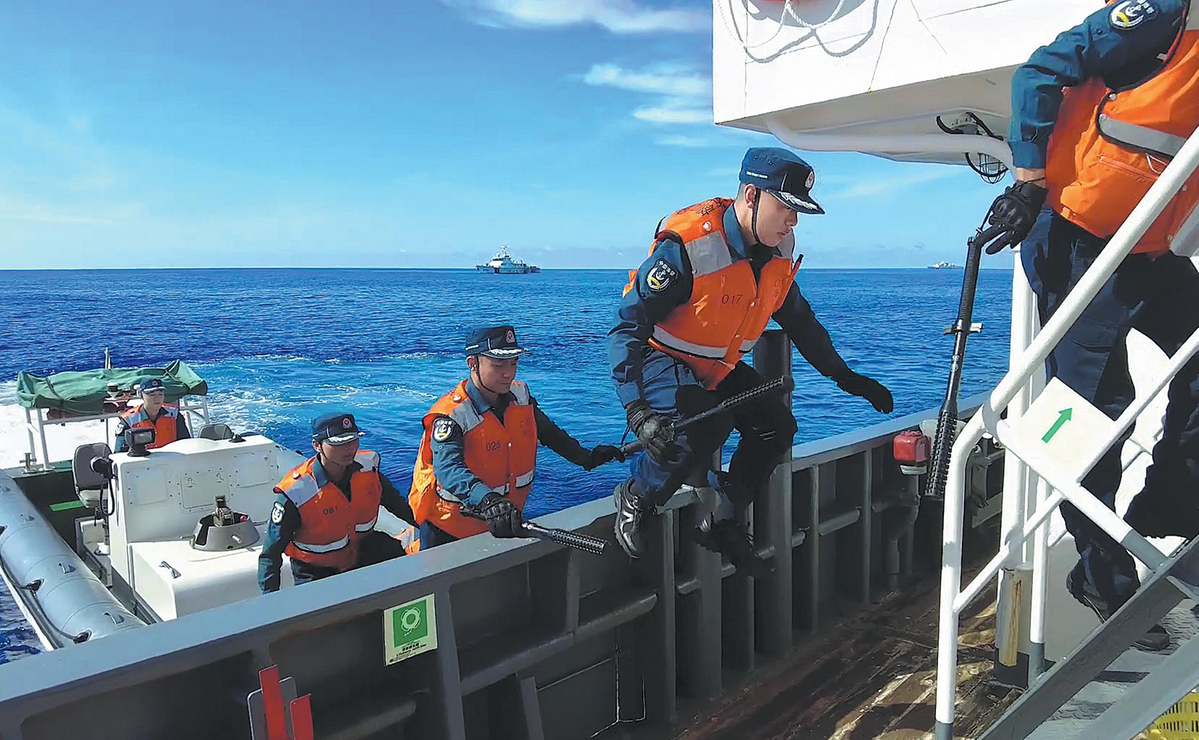
 China Coast Guard personnel conduct drills on Saturday in the waters near Huangyan Island. According to the China Coast Guard spokesperson, the drills focused on operations such as visit, board, search and seizure, interdiction of forced entry and forced towing. CHINA DAILY
China's latest diplomatic, military and law enforcement actions with regard to Huangyan Island reflect a more targeted and coordinated response to the Philippines' increasingly aggressive maritime, legal and diplomatic moves, experts said.
On Saturday, the People's Liberation Army Southern Theater Command conducted joint naval and air exercises in the territorial waters and airspace off Huangyan Island and its surrounding areas, while the China Coast Guard carried out rights-protection law enforcement and control drills in nearby waters.
According to separate statements issued by the command and the coast guard, the exercises covered reconnaissance and early warning, deterrence patrols, sea and air control, boarding inspections, interception and compulsory towing.
Ren Yuanzhe, a professor of diplomacy and foreign affairs management at China Foreign Affairs University, said China's response has become more targeted and coordinated, with maritime law enforcement being used alongside diplomatic and public communication efforts.
"The response demonstrates China's resolve to safeguard its sovereignty and maritime rights, while maintaining restraint and leaving room for practical cooperation, including maritime search and rescue," Ren said.
The actions followed a series of Philippine activities near Huangyan Island in late July.
Over two consecutive days, Philippine government and coast guard vessels entered Chinese waters, the China Coast Guard said.
During the larger operation, the Philippines assembled seven government vessels, three coast guard ships, one fishing vessel and a large number of fishing boats near the island. Three Philippine government vessels ignored repeated warnings and deliberately entered Huangyan Island's territorial waters, prompting the coast guard to take measures including verbal warnings, interception and control, and the use of water cannons, it said.
Zhang Qiyue, assistant director of the Shanghai Institutes for International Studies' Institute for Global Governance Studies, said the latest Philippine actions were larger, more organized and more multidimensional than previous sporadic incidents.
"They combined large-scale operations at sea with legal and diplomatic moves, showing that Manila is seeking to advance its claims through several channels at the same time," Zhang said.
The Philippines also deposited with the United Nations Secretariat a nautical chart setting out its claimed baselines, territorial sea and contiguous zone around Huangyan Island.
China firmly rejected the Philippines' delimitation of the so-called "baselines of the territorial sea" in a Foreign Ministry statement on Friday, calling the move illegal, null and void.
The ministry stressed that Huangyan Island has never been part of Philippine territory, which has been defined by a series of international treaties, and that Manila's territorial claim is completely baseless under international law.
It also reiterated that the so-called "award" of the unilaterally initiated "South China Sea arbitration" is illegal, null and void and has no binding force.
The developments came as 2026 marks the 10th anniversary of the announcement of the so-called arbitration award.
Zhang said the Foreign Ministry statement represented a continuation and further clarification of China's long-standing position on Huangyan Island.
It also helped the international community better understand the historical background of the issue, the legal basis of China's position and the nature of the Philippines' actions, she said.

