
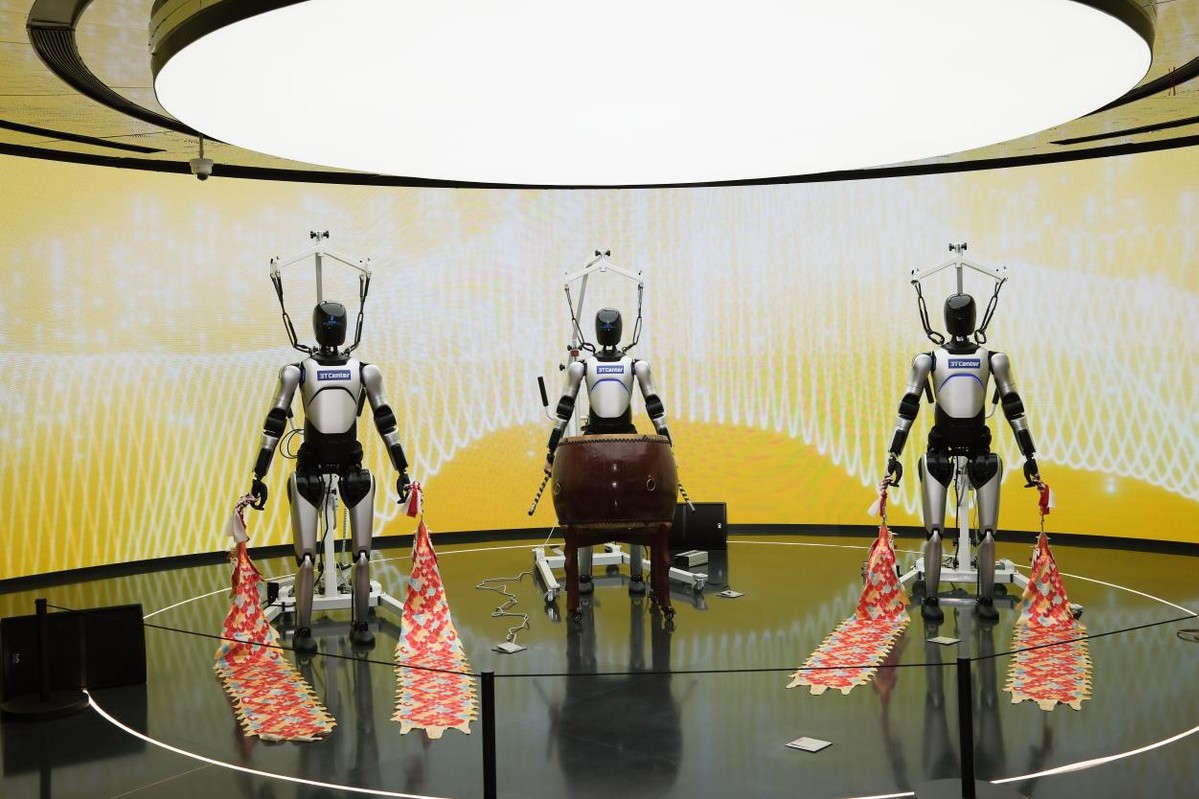
 Robots preparing to beat a drum and dance to music. [Photo provided to chinadaily.com.cn]
It is hard to imagine, without seeing it up close, a humanoid robot with a rigid metallic frame singing an excerpt from the classic Henan Opera Hua Mulan with controlled phrasing and stylized movements, or beating a drum and dancing to the rhythm of the popular song Da Hua Jiao (Wedding Sedan Chair).
But a recent visit to Henan Embodied Intelligence Industry Development Co, Ltd in Zhengzhou, capital of Henan province, challenged my long-held impression of cutting-edge technology as cold and distant.
The robots on display were strikingly versatile. In simulated farming scenarios, they performed agricultural tasks with well-practiced movements. In industrial settings, they handled factory logistics with precision. A moment later, the same machines could pick up a calligraphy brush, practice tai chi with fluid motions, or serve as exhibition guides.
How did these robots acquire such a wide range of skills across agriculture, industry, culture, and entertainment — and how are those skills being brought closer to real-world use?
As China enters the 15th Five-Year Plan (2026-30) period, the country has laid out a clear direction for intelligent industries: developing new quality productive forces, driving industrial innovation through technological innovation, advancing the "AI Plus" initiative, building application scenarios for future industries, and speeding up the transformation of frontier technologies into real-world productivity.
Embodied AI and humanoid robots are seen as important drivers of this process. The key question is how to bridge the gap between research and real-world application so that advanced technologies can truly serve industries and households. This training ground in Henan offers one practical answer.
Chen Yang, business manager at Henan Embodied Intelligence Industry Development Co, Ltd, used a vivid analogy to explain the process.
"When a humanoid robot first comes off the production line, it is much like a newborn baby. Its understanding of the physical world is almost blank," Chen said. "Our training center is like a preschool, and our researchers are like parents teaching the robots different skills."
Behind the simple analogy is a demanding process of data training. Chen told me that even stabilizing a basic movement can require hundreds or thousands of simulations. To build a scalable and generalizable model, tens of thousands or even hundreds of thousands of training iterations may be needed.
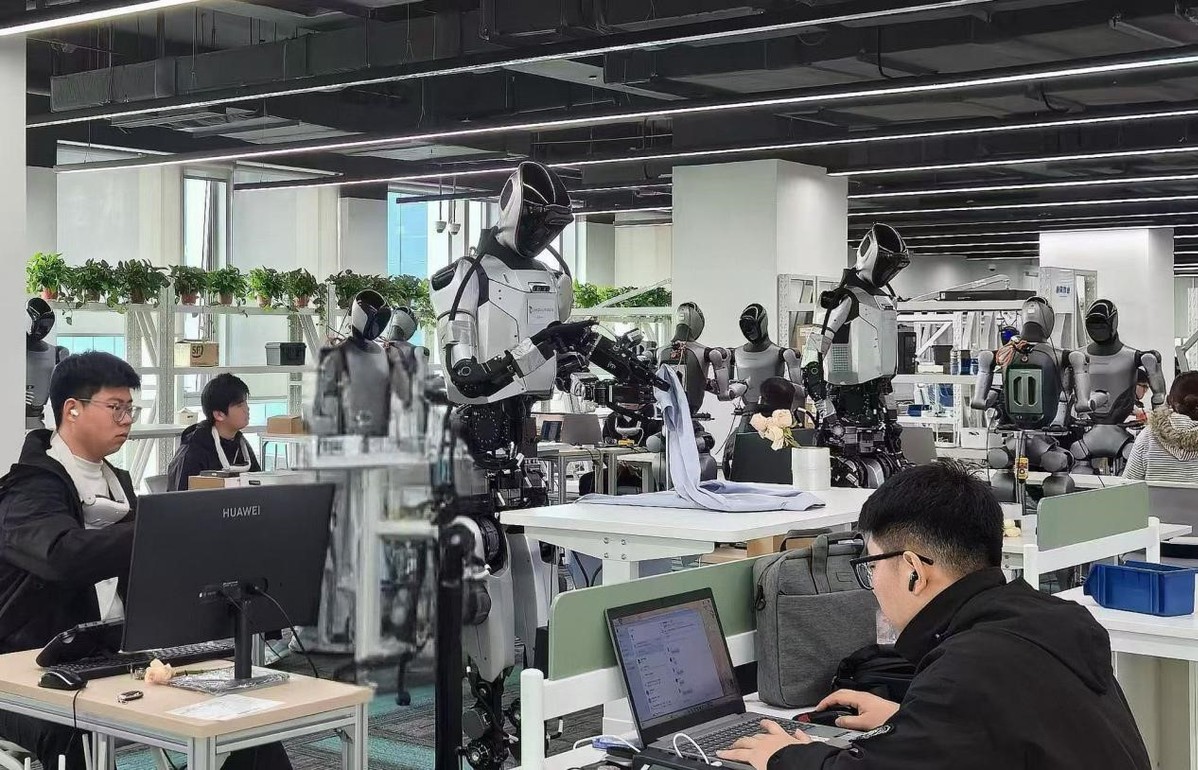 Staff members train a humanoid robot at a training center. [Photo provided to chinadaily.com.cn]
Figures provided during the visit show the scale behind that training. As China’s third platform — and the first in Central China — dedicated to embodied AI data training and scenario applications, the Central China Heterogeneous Humanoid Robot Training Center has deployed 140 humanoid robots across 27 high-quality real-world scenarios in six major fields.
The center has generated more than 20,000 hours of high-quality real-machine data. Such data are what allow these "newborns" to develop higher levels of accuracy, precision, and adaptability.
The broader national strategy must ultimately be measured by concrete steps toward industrialization and commercialization. A robot showroom and service center, which opened in March and allows customers to interact with the machines, is one such step.
"Our main goal is to shorten the distance between the public and embodied AI, and to help people feel that this technology is not remote or abstract, but accessible and capable of entering ordinary homes," Chen said.
When I stepped out of the company, the afternoon sunlight outside felt warm. Watching humanoid robots interact with visitors in the showroom, I realized that what I had seen was not only a display of technological progress, but also a glimpse of how the country’s blueprint for intelligent industries is taking shape at the local level.
The future of embodied AI no longer seems far away. It is being shaped step by step through data, grounded in everyday needs, and moving steadily toward real life application.

