
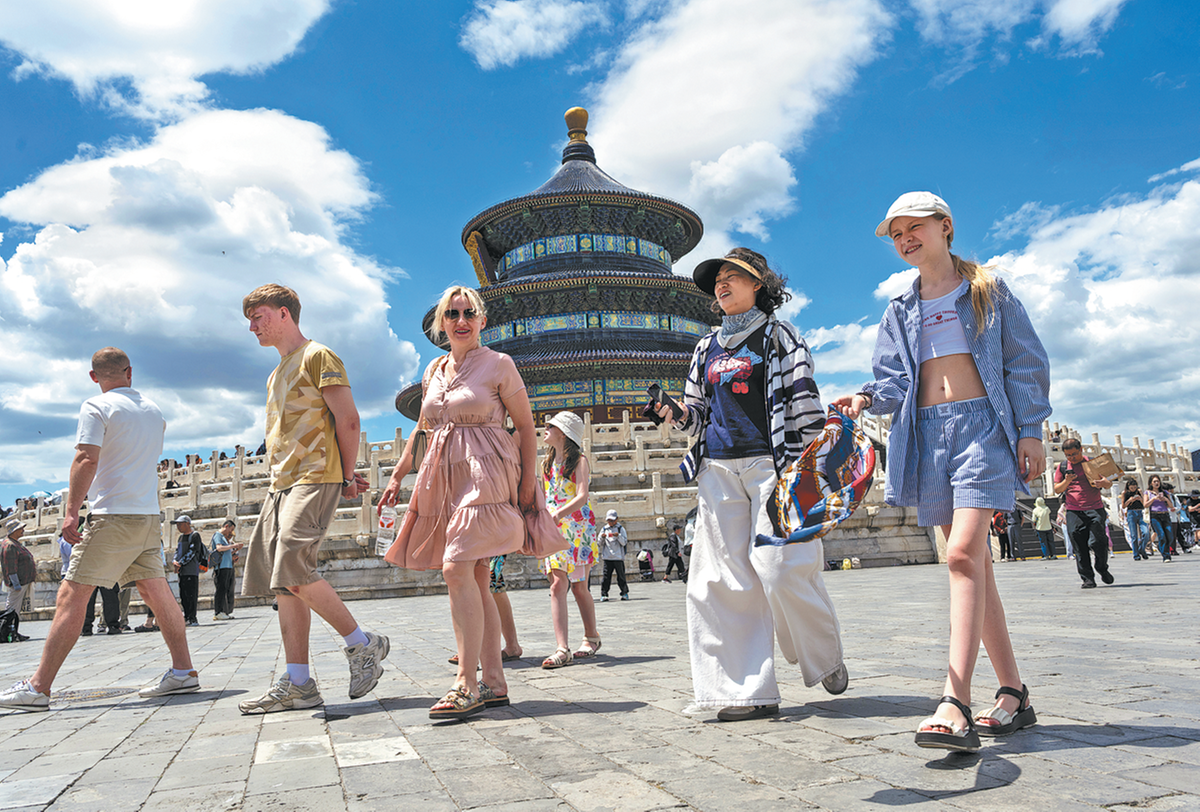
Foreign tourists visit the Temple of Heaven in Beijing on June 9. CHEN QIANG/FOR CHINA DAILY
Wolfgang Georg Arlt, a tourism expert from Germany, made his first trip to Beijing in 1978.
"There was almost no light at night," recalled Arlt, who has over 50 years of expertise, both academically and in practice, in tourism and hospitality. In the years since, he has watched China's tourism infrastructure improve steadily year after year, with better facilities and services.
In early June, he returned to the Chinese capital for a summit hosted by the World Tourism Cities Federation. During his stay, he was struck again by what he saw. But this time, it was by the smart infrastructure, services powered by artificial intelligence, and the gleaming skyline.
"No one back then could have imagined such development," said Arlt, executive director of the Meaningful Tourism Centre, based in London and Kathmandu.
As China evolves into one of the world's leading travel destinations, Arlt has also noticed a shift in the preferences of foreign travelers. "Tourism used to be about sightseeing, taking photos and shopping. Now people want to learn something and experience something," he said.
Technology has removed many of the old travel barriers. Instant translation services on a smartphone, for instance, mean no one needs to fear getting lost anymore, he added.

Overseas visitors try Chinese kebabs while wandering through the historical alleys of Qianmen Street in Beijing on June 14. CHEN QIANG/FOR CHINA DAILY
Active immersion
The shift from passive sightseeing to active immersion has been quietly reshaping China's inbound tourism industry.
On a March morning in suburban Beijing, Yang Li stood between a dozen foreign diplomats and a fully automated assembly line.
His job was to explain the factory's operations, but he soon realized the diplomats wanted China's overall transformation explained. "They were eager to know how the country built this," he recalled.
For nearly three decades, Yang had made his living explaining China's past — its dynasties, emperors, temples and ancient walls. Now, standing above a humming production floor where robotic arms moved in synchronization and driverless carts glided between workstations, he found himself explaining not just how the machines worked, but how China learned to produce them at scale.
The March visit had been arranged by China's Ministry of Culture and Tourism for foreign diplomats stationed in Beijing. "They didn't go to see the Great Wall. They came here to see why China can do this," he recalled.
For generations, China's inbound tourism narrative rested on familiar pillars: the Forbidden City, the Great Wall, the Terracotta Warriors. Visitors came to witness the remnants of an ancient civilization.
"Today, many international visitors no longer come only to admire China's past. They also want to understand its present — how factories operate, how cities function, how innovation is reshaping daily life and how traditions continue to evolve alongside rapid modernization," Yang said.
Spanish clients have asked to visit smart factories in Shenzhen, Guangdong province, while in Changsha, Hunan province, Romanian travel groups requested tours of electric vehicle production lines, he said.
A 2026 Trip.com Group survey of more than 500 inbound tourism operators found that nearly two-thirds identified meeting diverse visitor demands as their biggest challenge. More than 80 percent reported overseas visitors' growing interest in experiences beyond traditional sightseeing.
Tour operator Li Jieming is based in Zhangjiajie, Hunan. The city's best-known attraction is the cluster of sandstone pillars that inspired the floating mountains in the filmAvatar.
Three years ago, overseas visitors accounted for only a tiny share of his business. Today, they comprise around 60 percent.
The turning point came after China expanded visa-free entry policies for a growing number of countries in 2024.
"When I heard about the visa-free policy, I knew the number of inbound visitors would increase," Li said. "And Zhangjiajie already had something foreigners recognized — the Avatar mountains."
But his ability to seize the opportunity soon collided with new challenges: workers with foreign-language skills were scarce, and he had little overseas marketing experience.
Li began recruiting wherever he could find candidates — language schools, trading companies and returnees with international experience. His first international team consisted of just four people.
They posted videos of Zhangjiajie's landscapes on Facebook and handled inquiries one by one. Their first booking came from a Spanish couple who discovered the company online.
"We didn't make money on that booking," Li said with a laugh. "We just wanted to see if it could work."
By the spring of 2025, inquiries began arriving in waves. Today, Li's company employs more than 20 people serving international clients, and inbound tourism has become the core of the business.

A foreign tourist browses items at a trendy toy store in Shanghai in May. CHEN HAOMING/XINHUA
Content upgrade
Many of the inquiries came from people who had never previously considered traveling to Zhangjiajie.
Some discovered Zhangjiajie through social media videos of the towering sandstone pillars. Others arrived after seeing short clips of local customs and village life.
The influx of visitors quickly taught Li another lesson: attracting international travelers was only the beginning.
"Many foreign visitors don't want to spend the entire day checking attractions off a list," he said. "They want to interact with people and understand local life."
At first, his team offered itineraries similar to those designed for domestic tourists. The results were mixed.
"That's when we realized we had to help those people understand a place beyond simply touting the landscape."
One European family initially planned a simple cable-car excursion. Instead, Li's team suggested a gentle rainforest hike. "The children could touch plants, look at insects and ask questions," Li said. "It turned out that the parents loved it."
They applied the same idea to cultural tourism.
Rather than limiting visitors to performances and demonstrations, Li's company incorporates hands-on experiences such as Tujia ethnic brocade weaving, the Baishou dance — a Tujia group dance often performed at festivals and celebrations — and traditional silverwork.
"All those ensure our foreign guests don't just watch, but participate," he said.
Li mentioned a family from Germany that spent an afternoon learning Tujia brocade weaving.
"None of them had ever touched a loom before, and their finished cloth was uneven with imperfect patterns," he said. "But when the workshop ended, the mother got a bit misty-eyed and said it was something they made together, rather than simply a purchase."
For Li, the moment captured why so many travelers now seek experiences rather than attractions. "The mountains gave them a view," he said. "The weaving gave them a memory."
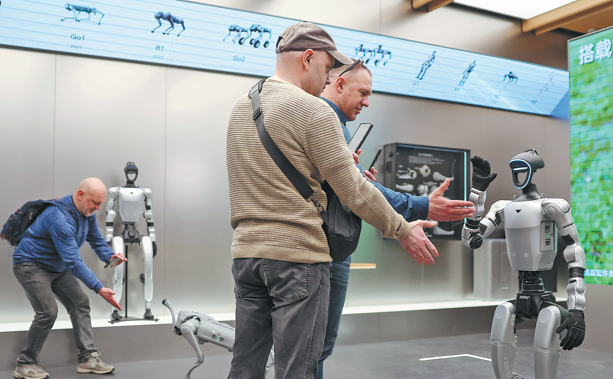
Tourists interact with robots at Unitree Robotics' flagship store in Beijing on June 2. JU HUANZONG/XINHUA
Deeper dive
Yang, one of China's first nationally certified gold tour guides, has witnessed nearly every stage of the industry's modern development.
The change, he said, has been particularly noticeable in recent years."Before, visitors listened to whatever you told them. Now they ask why," he said.
At the Great Wall, foreign tourists' curiosity isn't restricted to basic questions about its length, age or the construction techniques of the structure.
Instead, they want to know why the Great Wall occupies such an important place in the Chinese identity, Yang said. "One visitor even asked why it appears in China's national anthem," he said.
Yang's explanation begins with the ancient beacon towers that once signaled danger along China's northern frontier, and ends with the phrase from the national anthem — "using our flesh and blood to build a new Great Wall" — showing how a military defense system gradually evolved into a national symbol of endurance and unity.
He said an increasing number of overseas visitors make sense of modern China by comparing it with their own country's culture and history.
Spanish travelers draw parallels between the Great Wall and the Alhambra, a palace and fortress complex in Granada, while visitors from Latin America connect Chinese history with their own experiences of colonialism and nation-building, he shared.
For guides, this means understanding not only China but also the perspectives visitors bring with them. "If you don't understand their cultural background, you can't make the comparison meaningful," Yang said.
One Spanish architect, for example, asked him why Chinese walls were built with rammed earth while Spanish fortresses used stone. Yang didn't have a textbook answer but replied: "Different threats. Different materials. Different emperors."
The visitor nodded, and Yang said that was the moment he understood his real job.
At the end of May, nearly 2,000 tourism executives and industry professionals from 67 countries and regions gathered along the Lijiang River in Guilin, Guangxi Zhuang autonomous region, for one of China's largest inbound tourism events hosted by the local government and Trip.com Group.
Actor and filmmaker Jackie Chan, recently named an inbound tourism ambassador by Trip.com Group, greeted the crowd.
"My mission used to be bringing Chinese films to the world," he said."Now my mission is bringing the world to China."
A giant illuminated passport appeared in the night sky during a drone show. Moments later, a golden dragon flew through it as the words "VISA FREE" lit up the sky above the crowd.
The image captured one of the biggest changes driving China's inbound tourism recovery — the steady expansion of visa-free policies and the gradual removal of barriers that once discouraged international visitors.
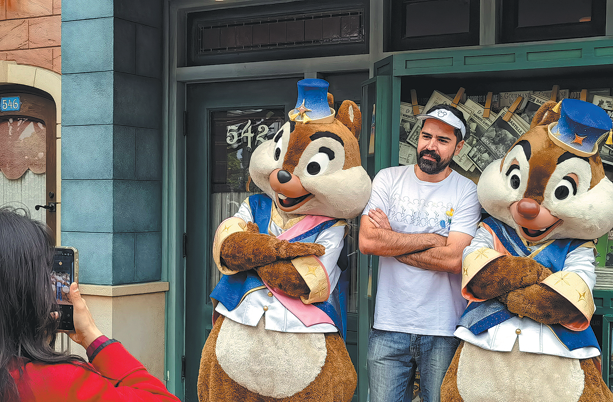
A visitor poses for a photo in Shanghai Disney Resort on April 28. CHEN AIPING/XINHUA
New storytellers
Visa-free entry can open the door, but content determines whether people choose to walk through it, many industry operators said.
Trip.com chairman James Liang announced that the company aims to attract 200 million inbound visitors over the next five years.
The tourism industry has already begun to adapt. Nearly 90 percent of inbound tourism employees have received some form of professional training. New job categories are emerging, ranging from inbound travel "customizers" to multilingual "experience designers" and cross-cultural content creators.
Yet, the industry's response remains uneven. While nearly two-thirds of practitioners feel service expectations have grown more demanding, fewer than 15 percent said lack of training is the main problem.
To become an outstanding guide for international visitors takes five to 10 years, Yang said. "Language ability, cultural fluency and the confidence to navigate complex conversations cannot be developed overnight," he said, adding that demand for Spanish-speaking guides, for example, has surged in recent years.
Yang speaks English and Spanish, has studied abroad, and traveled extensively. Years of experience have allowed him to understand both his visitors and the country he represents.
"Because what visitors are really doing is not just asking for explanations — they are interpreting China through their own cultural references. You need to understand those reference points as well as your own, so your answers are framed with meaning," he explained.
Many of Li's employees are from language schools, training centers and international trading firms and have never worked in the tourism industry before.
"Their language skills promise immediate and effective communication with potential clients," Li said.
"But they have to work hard to learn what the city has to offer and be capable of answering sophisticated questions based on that expertise. What visitors increasingly seek is not information alone. They want context, comparison and stories."
Experienced guides consistently earn more than newcomers, while regular training improves both service quality and income, industry figures showed. But income instability remains a concern. Tourism is highly seasonal, and many practitioners experience large swings in earnings between peak and off-peak periods.
For all the optimism surrounding inbound tourism's resurgence, the industry's growing pains are real, Li said.
Yang said being a tour guide is about creating understanding, a role he believes AI can never fully replace.
"AI can translate accurately. It can provide information," he said. "But it cannot read a visitor's eyes. It cannot create emotional connection."
In his 50s, he is still very optimistic about the industry's prospects, as more inbound visitors are requesting his services to understand a country still being built.
The Great Wall remains. So does the Forbidden City. But alongside them, a new set of destinations is emerging: factory floors, heritage workshops, innovation hubs and village studios.
"They all hold great sway over inbound travelers' curiosity and need guides like us to lead the way," he said.

