
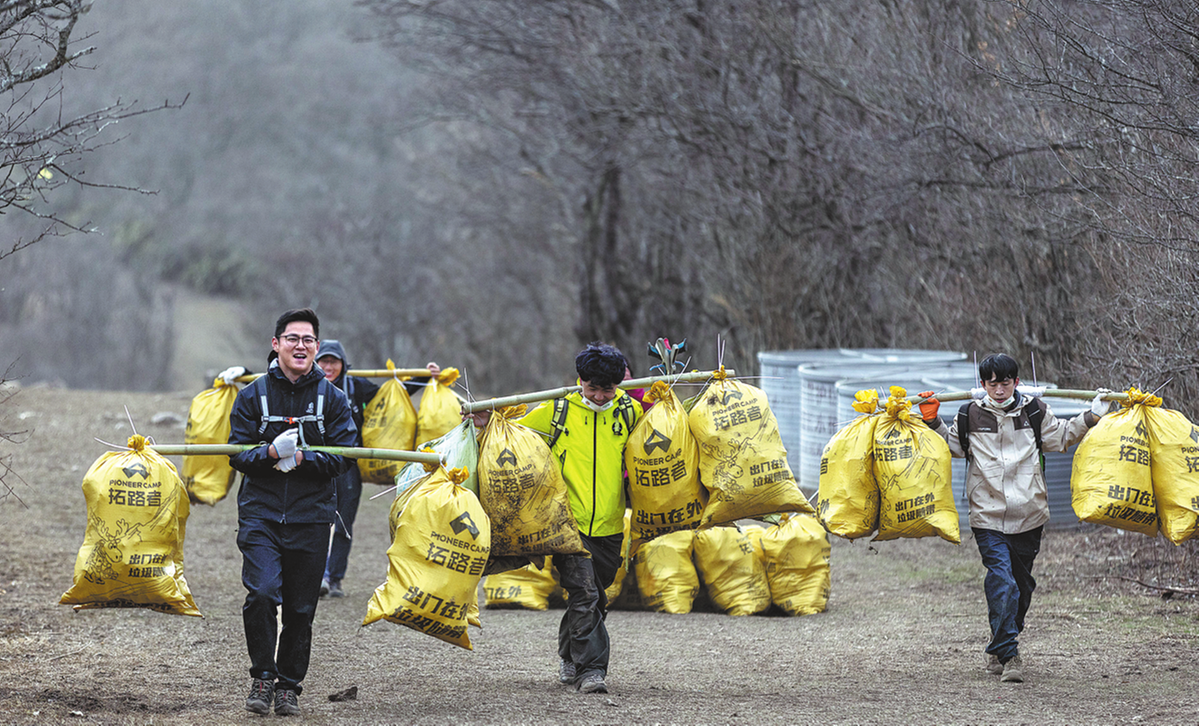
Volunteers collect garbage on Longwang Mountain in Huzhou city, Zhejiang province on Feb 23. YI FAN/FOR CHINA DAILY
Across China, a growing number of young people are spending their weekends doing something most hikers would rather avoid: picking up other people's trash. They crawl down steep slopes, sleep in tents in the wilderness, and haul soiled diapers and rotting food scraps from trails that regular cleaners cannot reach.
Their reward is not recognition or compensation, but the satisfaction of seeing the mountains a little cleaner than before. It is not about persistence; it is simply something they want to do.
Wang Zhonglei's cleanup journey began with a hike. A resident of Nanjing, Jiangsu province, 38-year-old Wang previously worked in cross-border e-commerce, selling products ranging from toys to clothing, and also taught Chinese as a second language.
A nature lover, he spent his weekends hiking in the mountains. "When I started hiking in late 2023, I noticed there was so much trash along the trails. Cleaners can't get to those places," he said.
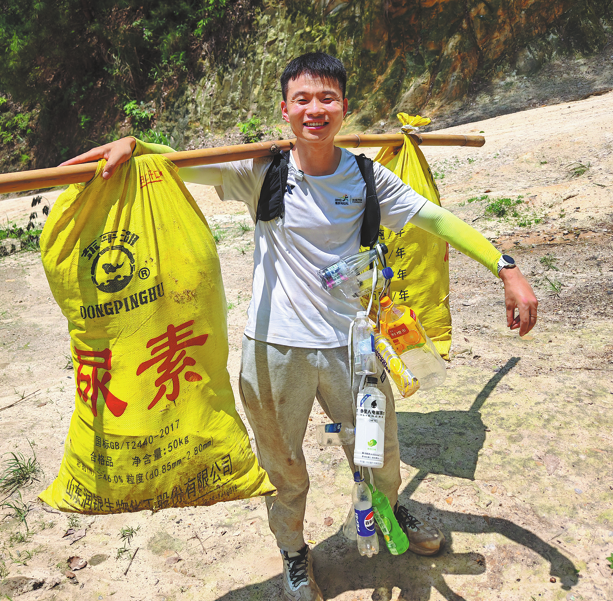
Huang Shengliang, Wang Zhonglei and his friend, and Chen Chen collect garbage on the mountains. CHINA DAILY
Volunteer group
Unable to find a local volunteer group dedicated to cleaning up the mountains, he decided to start one himself. He would take a trash bag on his weekend hikes and pick up trash from the trails.
But the more trash Wang picked up, the more there seemed to be. He realized that the effort needed more hands, and organizing volunteers demanded more time and energy than his job allowed. So Wang quit his job in 2024 to devote all his efforts to clearing trash from the mountains.
Wang's environmental awareness stretches back years. He learned about microplastics and their impact on human health while pursuing his degree in teaching Chinese as a foreign language. The foreign videos he translated on the subject left a deep impact on Wang.
"The average person ingests an amount of microplastics equivalent to the weight of a credit card each week. While a significant portion of these tiny particles is expelled from the body, not all of them are eliminated," he said.
Today, Wang supports himself by organizing eco-friendly events for brands, while the activities of his volunteer group for cleaning the mountains are free of charge. He provides trash bags and basic equipment to volunteers.
When weather allows, small teams of 10 volunteers head into the mountains to pick up trash. Some are trained climbers, while others have safety training. Together they clear trash from places that are hard to reach, including steep cliffs and crevices. The activities stop from June to September because it is very hot and there is a risk of snake bites.
It is arduous work. On one occasion, Wang was carrying about 20 kilograms of trash down a mountain when he fell and injured his lower back.
Mobilizing volunteers is also not easy. Some people join with enthusiasm but never return. "But some keep coming back. We have a volunteer who has participated in more than 20 cleanup events," Wang said.
But there are discouraging moments as well. During the Labor Day holiday, some hikers saw the volunteers carrying full trash bags and tried to toss their empty bottles in them.
"That made me angry. If we just take their trash for them, they'll keep littering when there is no one around to collect their trash," Wang said.
So the team started carrying biodegradable bags printed with the message "Don't litter". When someone tries to hand over their trash, the volunteers give them a bag instead and encourage them to take responsibility for their own waste.
What motivates Wang most is the knowledge that his group is inspiring others to follow suit. Last year, a hiker from Jiangyin, Jiangsu, saw Wang's team hauling bags of rubbish down the mountain. Inspired by the selflessness of their effort, he returned home and started his own cleanup group. That group is now larger than Wang's and cleans a local mountain about three times a week. "Sometimes people see us working and join us on the spot," Wang said.
Seeing less trash on the mountains also gives Wang more confidence. "On a few mountains we visit regularly, there's noticeably less trash. The situation is improving, and I've realized that we can really influence people."
Besides picking up trash, Wang and his team also teach hikers how to leave no trace outdoors.
"We recommend removing food packaging before departure, and using stainless steel or titanium containers to avoid creating trash. One should leave nothing behind but footprints," he said.
For Wang, the work doesn't require persistence because it never feels like a burden."If I didn't want to do this, that would take persistence," he said. "But this is just something I want to do. Every day I enjoy the positive energy that this gives me. I've created a good environment for myself, surrounded by positive people doing positive things. And I love every moment of it."
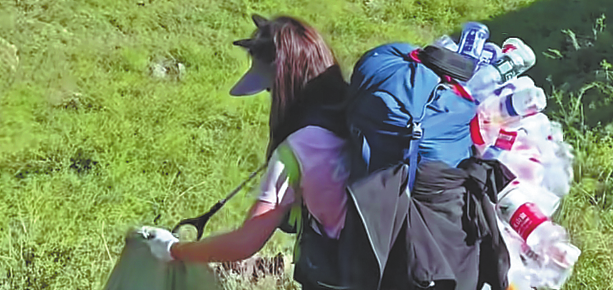
Huang Shengliang, Wang Zhonglei and his friend, and Chen Chen collect garbage on the mountains. CHINA DAILY
Female participant
Wang is not alone in this endeavor. Across the country, similar volunteer efforts are quietly gaining momentum. They come from different walks of life, but share the same zeal. They cannot bear to see the mountains being turned into dumping grounds.
Meet Chen Chen from Hangzhou, Zhejiang province, a 36-year-old avid hiker, cyclist and marathon runner. When she first joined a mountain cleanup event in 2018, it opened her eyes to a community of volunteers quietly dedicating themselves to protecting the environment. Chen has been working with them ever since. By day, Chen runs a rice noodle shop with her mother. But whenever she has time, she heads to the mountains for hiking and cleaning up trash.
She always carries a woven sack while hiking. Last year, she started stringing bottles together with a rope, sometimes collecting nearly 200 pieces. When she runs, the bottles clatter behind her. "It was the most beautiful sound in the mountains," she said. Chen's equipment is simple: just a face covering and gloves. "They protect me from branches and the sun. That's all I need," she said.
Sometimes she takes a train, walks to the foot of the mountain carrying her tent, and camps overnight in the wild. "Hotels are too expensive, so I just sleep in the mountains."
The trails Chen takes are usually more than 10 kilometers long. Each trip takes a full day. The paths are steep and slippery, and the trash can be heavy. Some people throw their garbage far off the trails, so she has to climb down to pick it up.
"My legs are bruised from the falls," she said. "What I don't understand is that people carry heavy food all the way up the mountain. After they have eaten, the packaging is light. Why can't they just bring it down?"
Chen sorts the waste on the spot. Non-biodegradable items such as cigarette butts, heat packs, and snack bags are put in trash bins. Bottles and cans are given to people who are willing to recycle them.
For Chen, the mountains have given her more than she expected. "When I'm up there picking up trash, I don't think about anything. There's only the trash, my breathing, and the scenery. I forget everything else bad. Sometimes I might even see a deer in the mountains. That is really healing," she said.
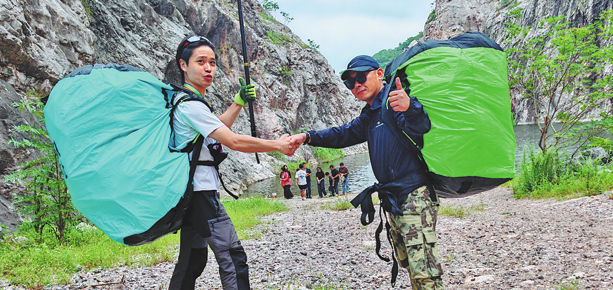
Huang Shengliang, Wang Zhonglei and his friend, and Chen Chen collect garbage on the mountains. CHINA DAILY
Meaningful work
Hundreds of kilometers away in the mountain city of Chongqing, another young man has found a similar sense of purpose. Huang Shengliang, 31, is an online retailer of home lighting who spends his free time picking up trash in the mountains.
His first cleanup happened almost by accident. After completing a marathon along a riverbank last year, he noticed litter along the riverside path and began picking it up with a friend.
This May, his attention turned to the mountains. "I saw so much trash on the hills. It just didn't feel right."
Since his online business gives him a flexible schedule, Huang can devote entire days to cleanup work. "I feel lucky that I'm not tied to an office. So I can do this to build up more good karma," he said.
Each bag Huang carries weighs around 15 kilograms. He doesn't find many bottles, but there are plenty of self-heating hotpot meal packs, which are quite heavy. The rain in Chongqing only makes things worse.
"The self-heating packs and diapers bloat up and become incredibly heavy. There are also water-soaked clothes and lots of muddy snack wrappers," he said.
"People might not have thrown them on purpose. They were probably left behind by mistake. Then strong winds and rain scattered them everywhere."
Huang has also noticed some hikers trying to hide their trash. "Instead of leaving it where it's visible, they throw it down the slope. Maybe they think that makes the trail look cleaner," he said.
But retrieving that trash is a difficult task. Huang had to slide down the slope and dig out the trash. "The leftover food was rotting and the smell was terrible," he said. Once, his face was completely swollen due to mosquito bites. Snakes are another major risk. "Whenever I have to go down a slope, I make a noise and use my litter picker to sweep through the grass to scare away any snakes," he said.
But the physical challenges don't stop Huang. "When I'm up there, I focus on one thing," he said. "I don't look at my phone. There's no restlessness, and I've become a lot calmer. Also, when you help others, you receive a lot of energy in return."
The online response from people has been overwhelmingly positive. "They said 'nice work' or 'thank you', making me realize this really matters," Huang said. "Lots of people think it's meaningful but they just don't have the time. But I can do this, so why shouldn't I?"

