
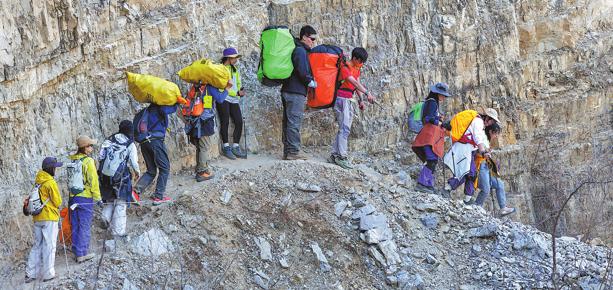
Garbage-collecting volunteers and hikers line up to pass a narrow section of a hiking trail on the outskirts of Beijing on March 29. WANG ZHICHENG/FOR CHINA DAILY
As hiking gains popularity across China, the growing litter on mountain trails is prompting local governments and volunteers to take action. From innovative cleanup campaigns conducted by the authorities to robot garbage collectors, new approaches are emerging to preserve the pristine beauty of the country's green spaces.
In Huixian city, Henan province, local authorities launched a mountain cleaning campaign in April along a popular hiking route of the southern Taihang Mountains, as reported by Henan Radio and Television Station.
The effort involved town governments that coordinated cleanup patrols, distributed trash bags along the route and set up waste transfer stations. Farmhouse inn owners are also being encouraged to remind hikers not to leave trash behind.
The aim is to instill a sense of responsibility in hikers so that they develop the habit of carrying their litter back down the mountain. The practice is gaining visible traction, according to local reports.
In March, more than 50 young volunteers in the Inner Mongolia autonomous region combined fitness with environmental action in a jogging event organized by the region's federation of supply and marketing cooperatives. As the volunteers jogged along mountain valleys and fitness trails, they picked up plastic bags, beverage bottles, paper scraps, and other trash from the grass and rock crevices along the way.
Technology is also being deployed to clean up the environment. According to a release by Beijing's Fangshan district government, four-legged robot rubbish collectors have been working on the Xishan Peak Scenic Forest Trail in Fangshan since June 3. The local government said the trial is part of a smart forestry project to deal with waste in difficult mountain terrain.
Robotic dogs equipped with garbage bags traversed the rugged mountain paths and steep slopes with ease. According to technicians, these robotic dogs have strong load-bearing and climbing capabilities, along with excellent terrain adaptability, reducing the physical burden on human volunteers, the release said. At the national level, the Chinese Society of Forestry, the China Tourism Association and the Chinese Mountaineering Association have jointly launched a "leave no trace" tourism initiative. The campaign calls on the public to take their rubbish with them, and reduce or avoid the use of single-use plastic products.
Gong Gu, a researcher at Peking University's Law School, suggested in an interview with Legal Daily in May that local legislation could establish a management system linking hikers' access to mountain areas with their environmental responsibilities. This system can include a requirement for deposits, which would be refunded only if hikers leave the area free of litter.
Authorities should set unified, clear standards for sanitation facilities in mountainous and wild areas and secure stable funding for their construction and maintenance. In addition, outdoor clubs, group hiking organizers, and outdoor information platforms need to be held accountable for their environmental responsibilities.

