

Dog owners bring their pets to a park in Anji county, Zhejiang province, on May 5, to participate in a dog beauty pageant. Anji county has been making various tourist attractions pet-friendly in recent years. PAN XUEKANG/FOR CHINA DAILY
When Zhang Yi packed her bags for a recent holiday trip to the grasslands of the Inner Mongolia autonomous region, she made sure one companion was not left behind: her beloved Shiba Inu.
The Chongqing-based pet owner has traveled with her dog to more than 20 cities across China, usually by car. On this trip, the pair camped on the vast Hulunbuir grassland, where her dog ran freely around the prairie.
"I treat my dog as family," the 31-year-old said. "I'm busy with work most of the year, so traveling together is a way for us to spend more time together and for my dog to experience new environments."
Zhang is part of a growing wave of Chinese travelers who refuse to leave their "furry children" behind. Once considered a niche hobby among dedicated pet owners, traveling with animals is increasingly shaping China's tourism market, from hotels and campsites to transportation and destination services.
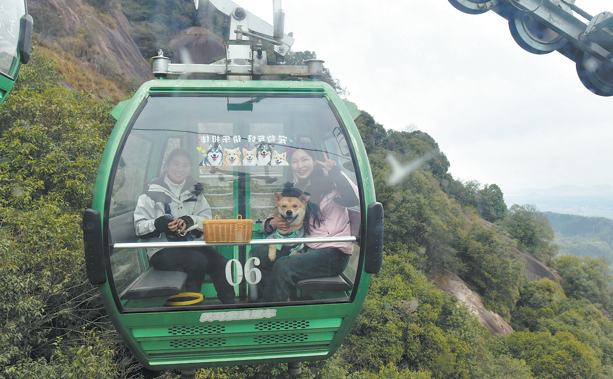
Tourists with their dog take a cable car ride at the Jiuziyan Scenic Area in Qingyang county, Anhui province, on Feb 9. CHU WEIWEI/CHINA NEWS SERVICE
Data from online accommodation platform Tujia.com show that bookings for homestays labeled as "pet-friendly" during the five-day May Day holiday in 2025 rose more than 80 percent from a year earlier, while the number of such listings on the platform increased fivefold. Industry participants say the momentum has continued into 2026 as more travelers seek accommodations that allow pets.
The trend reflects a broader shift in consumer behavior as younger Chinese view pets less as animals and more as companions integrated into their daily lives.
"We see pet-inclusive travel as a structural trend rather than a short-term fad," said Kathy Jiang, a partner expert at consultancy Roland Berger. "It is driven by the growing perception of pets as family members and the consumption upgrade among younger pet owners."
China's tourism industry is now moving from simply allowing pets in certain venues toward actively designing services around them, Jiang said, although standards and supporting facilities remain uneven.
China's broader pet economy provides a powerful backdrop. The 2026 China Pet Industry White Paper (Consumer Report) said the number of pet dogs and cats in the country's urban areas exceeded 120 million, with the market for pet-related consumption reaching about 312.6 billion yuan ($45.92 billion) in 2025. The market is expected to expand further to 405 billion yuan by 2028.
The report found that 71 percent of pet owners expressed interest in traveling with their animals, and about half had already paid for pet-related travel services.
Tourism operators say the change is already visible in bookings. At the Hu Resort in Beijing, which began developing pet-friendly services in 2019, demand has risen sharply in recent years. Shang Li, the resort's marketing manager, said inquiries, visitor numbers and bookings for pet-friendly rooms during this year's May Day holiday all doubled from a year earlier.
Shang said most guests traveling with pets are young urban professionals aged 25 to 40, who treat their animals as family members and typically seek short leisure breaks in suburban destinations.
Compared with ordinary guests, these travelers often stay longer, return more frequently and spend more on dining and other services, she added.
Travel agencies are experimenting with niche offerings. Outdoor travel platform Youxiake.com launched a pet travel brand in 2024, offering short-distance hiking and holiday itineraries designed for travelers with pets.
Li Yunzi, the company's general manager, said professional pet travel involves far more than simply allowing animals to join a trip.
"It means designing the experience from a pet's perspective rather than treating them as passive companions," Li said in an interview with The Economic Observer, noting that routes are screened to ensure suitable terrain, rest stops and outdoor space for dogs.

A man and his dog walk through the streets of the old town of Linhai in Taizhou, Zhejiang province, on May 4. YI FAN/FOR CHINA DAILY
Meanwhile, local governments and tourism operators are increasingly trying to capture a share of the growing market.
More than a dozen Chinese provinces and cities have introduced policies encouraging the development of pet-friendly tourism as part of the broader pet economy. Measures range from supporting pet-themed events to encouraging hotels, scenic areas and campsites to develop dedicated facilities.
For now, most pet travel in China remains short-distance and car-based. On highways and in suburban campsites during the May Day holiday, it was common to see pets accompanying their owners. Many travelers prefer driving to nearby destinations, which allows flexibility and avoids complicated transport restrictions.
Cross-province trips by air or train remain far less common.
Li Mengran, marketing manager at Beijing-based travel agency Utour, said the company's dedicated pet travel brand PetGo — launched in January — has seen steadily rising inquiries from travelers hoping to bring pets along.
However, actual bookings did not increase significantly during the recent May Day holiday because of soaring airfares.
"The main customer group for pet travel is young travelers, who tend to be price-sensitive," Li said. "During holidays, air ticket prices rise sharply. That filters out many potential customers even if interest is high."
Pet owners also tend to prioritize keeping their animals close throughout the journey. If airlines only allow pets to travel as checked cargo, many customers abandon the idea entirely.
"The possibility of pets staying in the cabin is often the first question travelers ask," Li said.
Transportation rules have long been one of the biggest bottlenecks for pet travel in China, though recent policy changes suggest gradual improvement.
In April, China expanded a pet transport service on its high-speed rail network, allowing pets that meet certain requirements to be checked as cargo on more than 200 train routes across more than 120 stations, according to China Railway Express.
Airlines are also experimenting with pet-friendly services. Carriers such as China Southern Airlines and Xiamen Airlines have launched limited trials allowing small pets in aircraft cabins on selected routes, while some airports in cities including Shenzhen and Guangzhou in Guangdong province have introduced pet lounges and specialized check-in counters.
These developments are gradually removing some of the logistical barriers for travelers hoping to bring pets along.
Industry experts say the impact of pet travel extends well beyond tourism itself.
Jiang of Roland Berger said the sector could stimulate a wider supply chain, from travel gear and in-car pet equipment to smart wearable devices and pet healthcare services.
At destinations, the trend may encourage scenic areas to develop pet-walking trails, campsites to offer dedicated facilities and local businesses to expand into services such as grooming, pet photography and post-trip health checks.
"In essence, travel spending shifts from 'one person' to 'one person plus one pet', which significantly raises the average spending per visitor," Jiang said. "It can also help destinations attract off-season traffic."
Despite the rapid growth, the industry still faces major challenges.
China lacks unified rules governing pet access to hotels, scenic areas and transportation, meaning travelers often have to confirm policies repeatedly before departure.
"In Europe and the United States, pet-friendly travel is already integrated systematically into transportation, accommodation and public spaces," Jiang said. "In China, the biggest problem is that policies remain inconsistent and sometimes change without clear notice."
Emergency services, transport connections and deeper experience offerings also remain underdeveloped, making it difficult for travelers to enjoy a seamless end-to-end journey with their pets.
For Zhang Yi, the Shiba Inu owner from Chongqing, the progress is nevertheless visible.
"China still has a long way to go in becoming fully pet-friendly," she said. "But compared with a few years ago, the environment for traveling with pets has clearly improved."

