
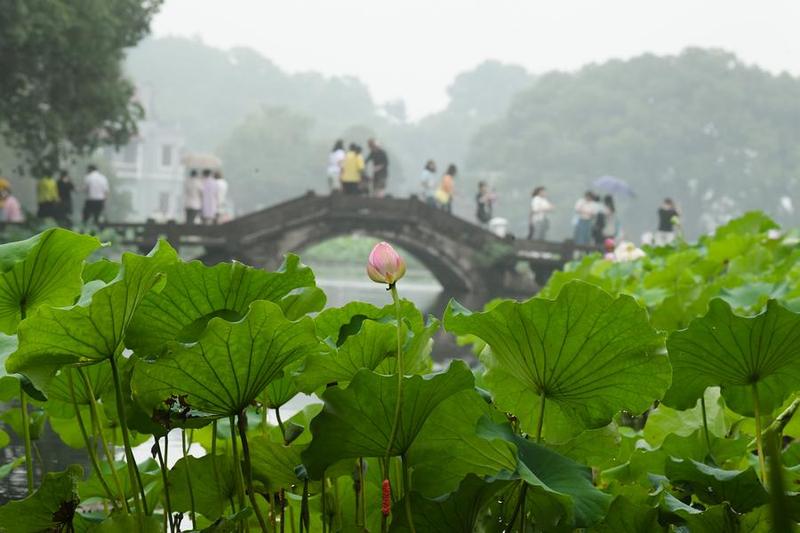
Tourists view lotus flowers at the West Lake scenic spot in Hangzhou, East China's Zhejiang province, June 24, 2025. [Photo/Xinhua]
Every morning, boatwoman Chen Meifang steers her canopied wooden vessel across Hangzhou's West Lake, guiding tourists past arched bridges, willow-lined banks and pagodas reflected in the still water.
For a thousand years, the lake has inspired poets and painters; for Chen, it is a living reminder of a decision that forever changed how people experience Hangzhou's most beloved landmark.
In 2003, the fences surrounding the West Lake were torn down, and every park around it became free to enter — a move launched under the leadership of Xi Jinping, then Party secretary of Zhejiang province.
The policy turned the West Lake from a scenic enclave into a shared public space, allowing both residents and tourists to enjoy its beauty without barriers.
"Every part of this lake tells a story — of history, of change, of the people who live by it," Chen said. "And we still feel that every day."
The decision reflected a broader vision Xi was charting that year — the Double-Eight Strategy, a development blueprint that continues to define Zhejiang's path two decades on.
The strategy identified eight of Zhejiang's core strengths, including institutional advantages, geographical location and cluster-based industries, and laid out eight initiatives to leverage them, ranging from industrial upgrading and urban-rural integration to environmental protection and maritime development.
It also called for leveraging Zhejiang's cultural and human resource strengths by invigorating the province through science, education and talent development, and by building Zhejiang into a province with a strong culture.
At the time, Zhejiang's economy was entering a critical transition phase. Its GDP stood at 800.4 billion yuan ($113.2 billion) in 2002, ranking fourth among Chinese provincial-level regions, but faced challenges such as power and water shortages, as well as land supply constraints. The profits of industrial enterprises above a designated size across the province showed a slide in the past, according to local media reports.
From the challenges, Xi, who is now Chinese president and general secretary of the Communist Party of China Central Committee, saw an opening — to upgrade the province's economic structure and transform its model of growth.
"The Double-Eight Strategy was a top-level design tailor-made for Zhejiang. It serves as the province's overarching program, master strategy and guiding blueprint for advancing Zhejiang's new phase of development," said Guo Zhanheng, former deputy head of the policy research office of the CPC Zhejiang Provincial Committee. "It was not only a plan for prosperity, but also for balance — between city and countryside, between growth and ecology, between efficiency and fairness."
Xi wrote in a column in Zhejiang Daily in 2004: "GDP, fiscal revenue and household income are all important indicators, but they are not the ultimate goal. The ultimate goal is to promote the all-around development of people."
Two decades on, the transformation has been remarkable. By 2024, Zhejiang's GDP had soared to 9.01 trillion yuan, a more than 11-fold increase compared with its 2002 level. Per capita GDP reached 135,500 yuan, far above the national average.
The income gap between urban and rural residents has narrowed dramatically. Urban incomes are now just 1.83 times of rural ones, the smallest ratio among all Chinese provincial-level regions.
Zhejiang has also led national rankings for rural living environment improvement for several years.
Xi's philosophy of balance took visible form at Hangzhou's West Lake, the destination of his first fact-finding trip upon taking office as Party secretary of Zhejiang province in 2002.
He placed special emphasis on the lake's comprehensive restoration project, a decade-long effort to clean its waters, remove illegal buildings and restore cultural relics, as pollution and overcrowding in the 1990s had dulled the lake's luster.
Pan Cangsang, curator of the West Lake Museum, said the comprehensive protection program sought not only to restore the lake's ecosystem, but also to reconnect people with its culture.
The program ultimately helped the West Lake Cultural Landscape gain UNESCO World Heritage status in 2011.
"He proposed building our museum himself, because he believed understanding the past was the key to protecting it.
"The Double-Eight Strategy is visionary and has played a crucial role in guiding the development of Zhejiang, Hangzhou and the West Lake," Pan said.
She added that Xi displayed a genuine concern for culture and history, and a clear understanding of how important this lake is to the city of Hangzhou as the projects continued.
Two decades on, Pan said that the lake is now in the best condition it's been in history.
Ports integration
That same philosophy of integration extended from inland lakes to the province's bustling coastline.
Xi pushed to merge the Ningbo and Zhoushan ports into a single entity — a reform launched in 2006 that created what is now the world's busiest cargo hub, which handled more than 1.37 billion metric tons of goods in 2024.
Zhu Shijie, head of the quay crane unit from the Chuanshan port area of the Ningbo-Zhoushan Port, said that the two ports, which used to compete for shipping traffic, have since become partners after the integration.
He explained that Xi's proposal for developing Zhejiang into a maritime powerhouse has spurred the development of the port's cargo throughput, especially in terms of containers.
"Based on our respective geographical advantages, we were able to develop in a more coordinated way," Zhu said.
The progress was swift. In 1999, the port handled just half a million twenty-foot equivalent units. By 2006, that number reached 7 million, with Xi himself pressing the button to lift the milestone container, and Zhu operating the crane. Last year, the port's throughput hit 39.3 million TEUs.
"I have so far conducted three conversations with General Secretary Xi, from which I can feel his care and attention toward the integrated development of the Ningbo-Zhoushan Port," he said.
Growing investment
The Double-Eight Strategy also set the stage for Zhejiang's sharp rise in foreign investment. From 2003 to 2007, the province attracted $39.1 billion in actual foreign direct investment, growing at an average annual rate of 26.8 percent.
In Ningbo, the Nordic Industrial Park, launched in 2002, became a magnet for Scandinavian companies.
"We rode the wave of the Double-Eight Strategy," said Wang Haiting, the park's general manager. "It emphasized openness and advanced manufacturing, and that's exactly what foreign companies were looking for."
For Claus Rasmussen, general manager of BarkerBille Fans Manufacturing, a Danish company producing high-efficiency industrial fans in Ningbo, Zhejiang's infrastructure and supply networks made all the difference.
"Around here, you can find almost every supplier a company might need," he said. "You can produce everything within a short distance."
He noted that Zhejiang was among the first provincial governments in China to launch one-stop services, while local authorities have remained committed to providing better legal and tax services for businesses.
Guo, former deputy head of the provincial policy research office, said the Double-Eight Strategy has guided Zhejiang to a historic transformation. "From a focus on growth alone to all-around development; from low-end to high-end manufacturing; from environmental pollution to environmental friendliness, the strategy was — and remains — a strategy for the people, ensuring all residents share the fruits of progress."
Wang Hao, the province's current Party secretary, said in November 2024 that the Double-Eight Strategy has provided "an inexhaustible source of valuable wealth for advancing Zhejiang's development".
Over two decades, he said, the strategy has helped Zhejiang overcome the "growing pains" of modernization, achieving a "comprehensive, systemic and profound transformation".
The task ahead is to sustain high-quality growth while narrowing regional and income gaps and ensuring that development continues to serve its original purpose — improving people's lives, he added.

