
Click on the video above
NB: This is not a word-for-word transcript
Traditional tea processing techniques and their associated social practices in China were officially added to UNESCO's Representative List of the Intangible Cultural Heritage of Humanity on November 29.

Jun porcelain tea set. [Photo provided to dahe.cn]
Located in the hinterland of China's Central Plains, Henan province has fertile land and is rich in water resources, thus creating a favorable environment for growing green tea and black tea. Xinyang Maojian tea, a specialty of Henan's Xinyang city, is one of China's top ten most famous teas. It is worth noting that a new batch of demonstration areas of GI (geographical indication) product protection has been released by the China National Intellectual Property Administration recently, Xinyang Maojian tea included, the only one in Henan.
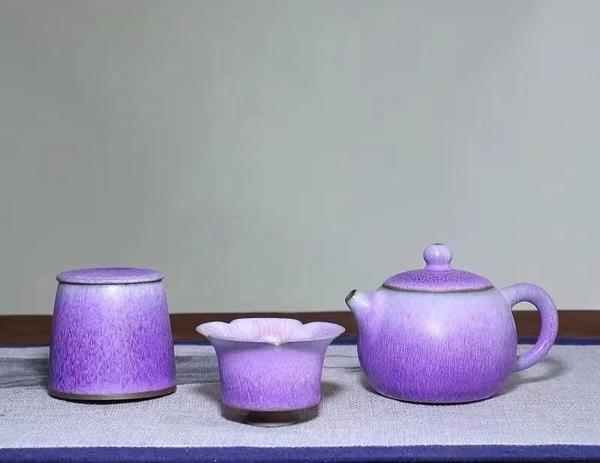
Jun porcelain tea set. [Photo provided to dahe.cn]
As an old saying goes, a cup of tasty tea is inseparable from a good tea set. Originated in today's Yuzhou city of Henan province, Jun porcelain, one of the top five royal porcelain varieties of the Song Dynasty (960-1279), is famous all over the world for its uncontrollable glaze color changes during firing in kilns. Jun porcelain tea sets are of both artistic and practical value. Now, let's have a glimpse of Chinese tea culture through some classic Jun porcelain tea sets.

A tureen with two cups. [Photo provided to dahe.cn]
A Jun porcelain tea set consists of eight utensils, including a teapot for brewing tea; a teapot tray for protecting the table from hot water; small teacups for drinking tea; teabowls for brewing tea or storing hot tea drink temporarily; tureens and big teacups are utensils for brewing or drinking tea; a filter cup for separating tea leaves from water; a fairness mug for serving other tea drinkers. (Text: Zhao Hanqing Yang Jiaxin Video: He Menhe Proofreader: Zhang Junping Photo: Yan Xiaoming)

